What Is Remote Vessel Operations in Inland Shipping?
How shore-based navigation actually works, how it differs from autonomous shipping, and where it is permitted in Europe today.
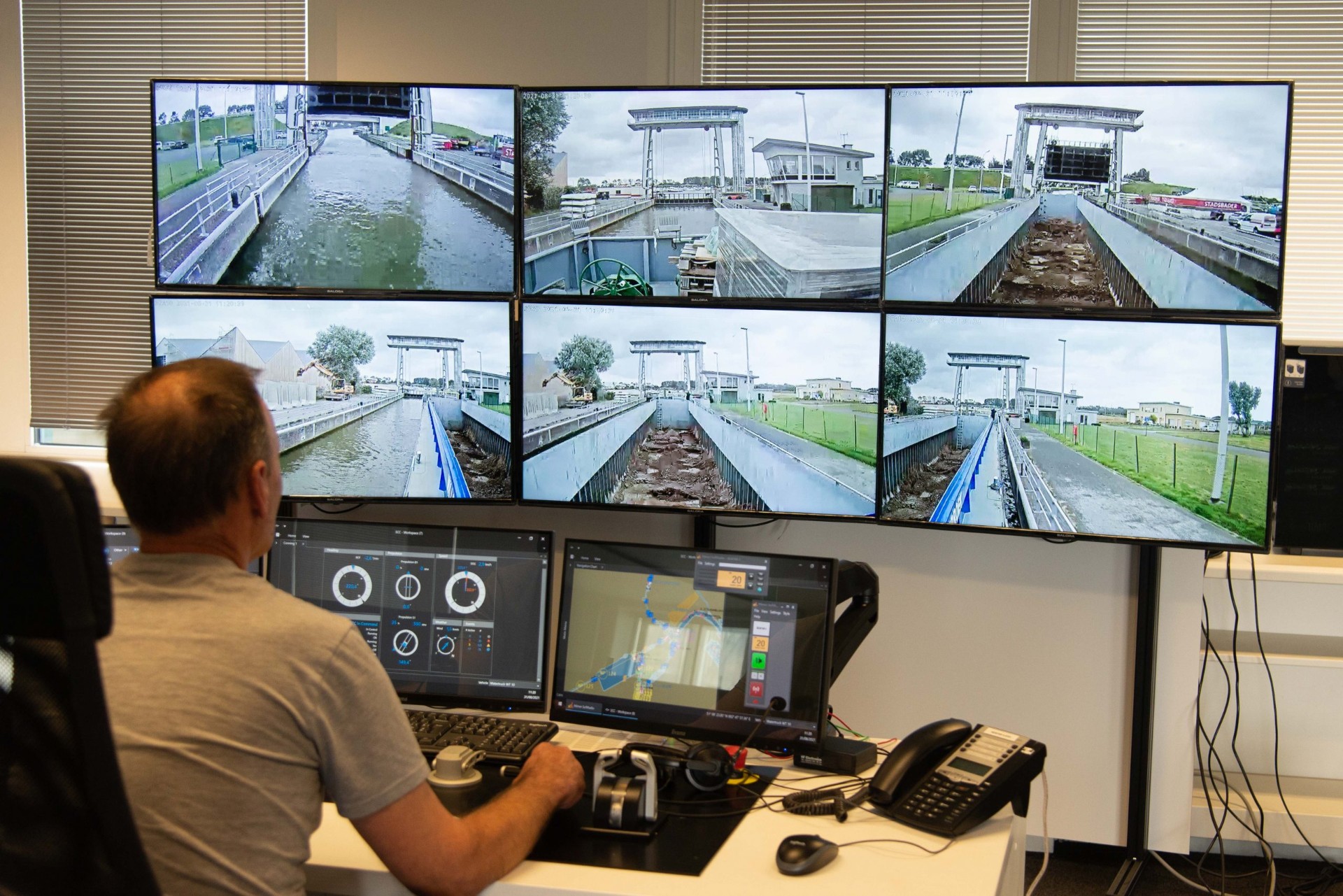
Remote vessel operations is the practice of navigating an inland shipping vessel from a shore-based control room instead of from the wheelhouse. A certified Remote Operator in a Remote Operation Center (ROC) monitors and steers the vessel over a secure data link, while a smaller crew, or in some cases no navigational crew, remains on board. It is in commercial use on inland waterways in Belgium, the Netherlands and Germany.
- The navigational task moves from the wheelhouse to a shore-based Remote Operation Center. It does not remove human judgement from the loop.
- It is not autonomous shipping. The CCNR does not classify remote control as a form of automation at all.
- Crew-reduced navigation is the commercial outcome. Remote operations is the capability that makes it possible.
- There is no single European authorisation. Permission is granted nationally, project by project, through permits and regulatory derogations.
- The main driver is a structural shortage of qualified boatmasters, not a search for novelty.
What is remote vessel operations?
Remote vessel operations means that the person performing the navigational task is not on board. The vessel is fitted with sensors, cameras, control interfaces and a redundant data connection. That data is transmitted to a Remote Operation Center on shore, where a Remote Operator with an inland navigation qualification monitors the voyage and, when authorised, takes direct control of steering and propulsion.
Three terms are routinely used as if they mean the same thing. They do not, and the difference matters commercially and legally.
| Term | Who is in command | What it means |
|---|---|---|
| Remote support | Boatmaster on board | The boatmaster stays on board and in command. Nothing changes about the crew requirement. |
| Remote control | Remote Operator ashore | The shore-based Remote Operator performs the navigational task. Control has been formally transferred off the vessel. |
| Crew-reduced navigation | Shared, under permit | Fewer people on board than the conventional requirement, because shore capacity replaced part of the onboard function. Requires regulatory permission. |
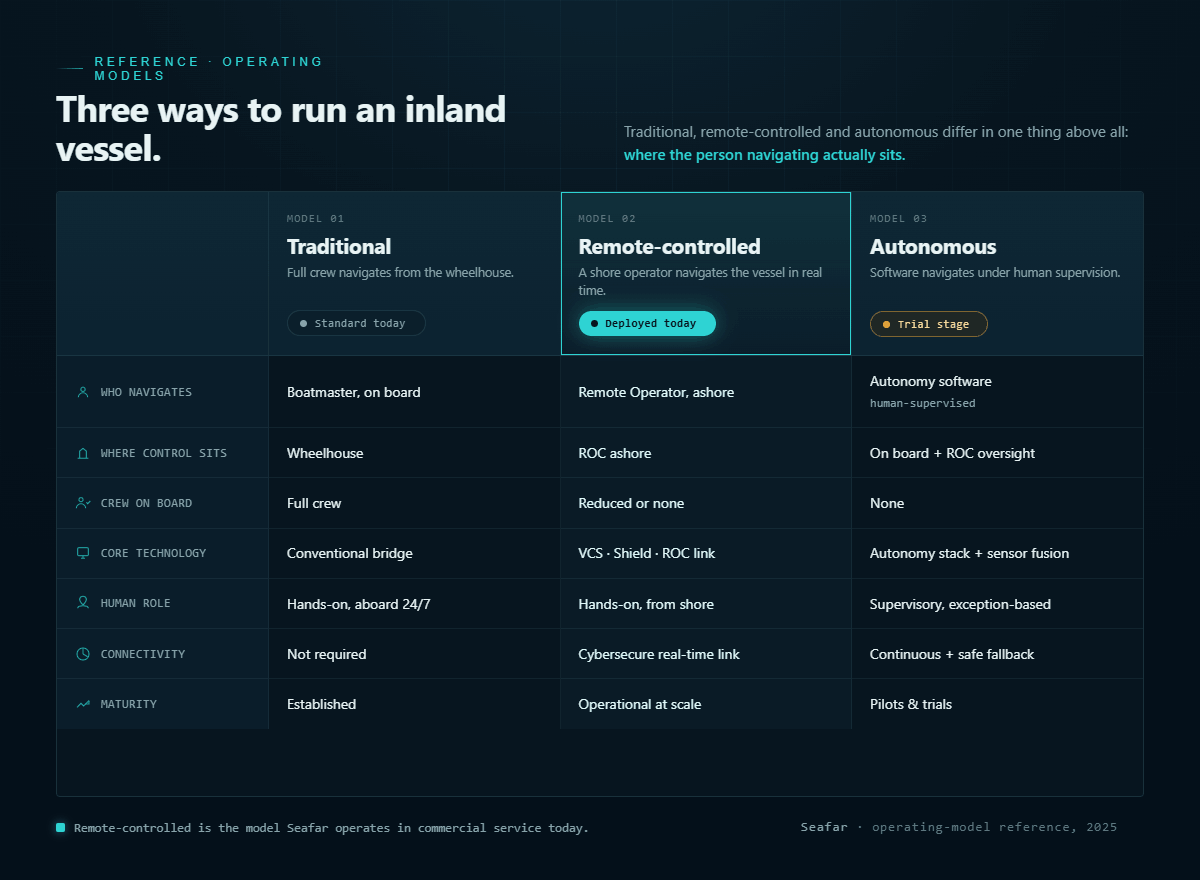
Terminology in this field is not cosmetic. The CCNR published a four-language terminology for automated navigation and remotely operated craft in November 2023 precisely because inconsistent language between operators, technology suppliers and authorities was slowing down authorisation. Throughout this guide, boatmaster refers to the person in command on board, and Remote Operator refers to the qualified person operating the vessel from a ROC.
How does remote vessel operations work?
A remote operations setup has four layers. Each one has to hold for the voyage to proceed, and each one is a separate engineering and compliance question.
A Vessel Control System (VCS) is interfaced with existing navigation, steering and propulsion equipment. It collects sensor, camera, radar, AIS and engine data, and accepts control commands from shore. Control never moves to shore silently: it is an explicit, logged handover.
Remote navigation depends on a connection that degrades predictably rather than failing outright: a primary satellite link with fallback paths, with vessel control traffic isolated from general-purpose internet traffic. A control channel to a moving vessel is a safety-critical system.
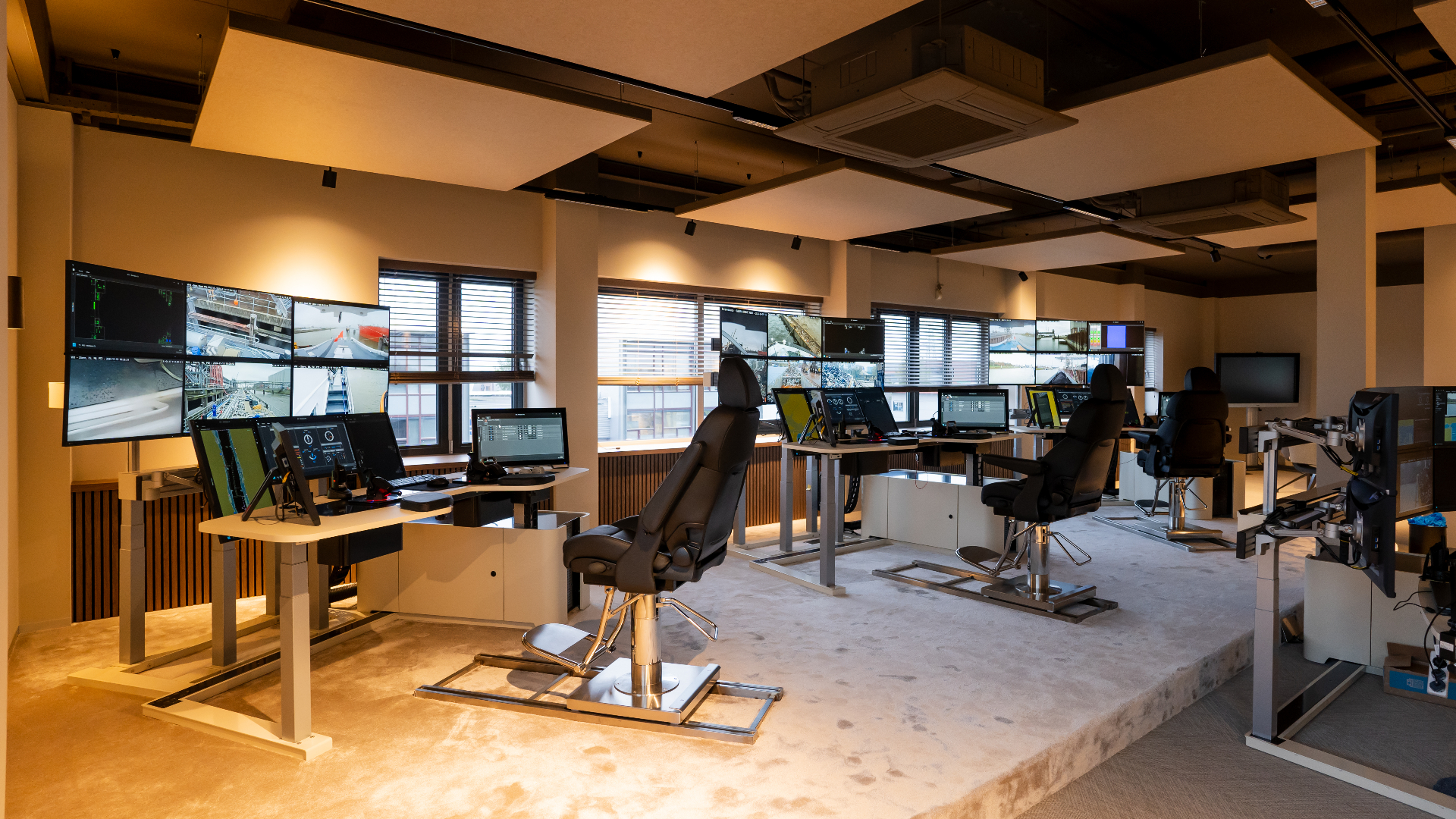
A Remote Operation Center houses one or more Remote Operation Stations (ROS). Each reproduces what a boatmaster would have in a wheelhouse: camera views, radar, electronic chart, AIS traffic, engine and rudder feedback, VHF. Operators work in shifts, which is the point.
Three functions sit above the individual voyage. Atlas configures geofences for compliance and notification. Watchtower logs and reports every voyage, giving owners visibility and authorities an audit trail. CrewLink matches vessels with available Remote Operators by route, vessel type and certification.
What a voyage looks like in practice
The vessel departs under the boatmaster's command, on board, as normal. Approaching a stretch covered by the operating permit, the boatmaster requests shore support and CrewLink assigns a Remote Operator. The Remote Operator confirms readiness, the boatmaster authorises the transfer of control at the Console, and the handover is logged.
The Remote Operator then navigates from the ROC, and any excursion from the geofenced permitted area triggers an Atlas notification. If connectivity or system health degrades below a defined threshold, the vessel reverts to a predefined fallback state and control returns on board. At the end of the covered stretch, control is transferred back and Watchtower closes the voyage record. There is never ambiguity about who is navigating.
Remote operations vs autonomous vessels: what is the difference?
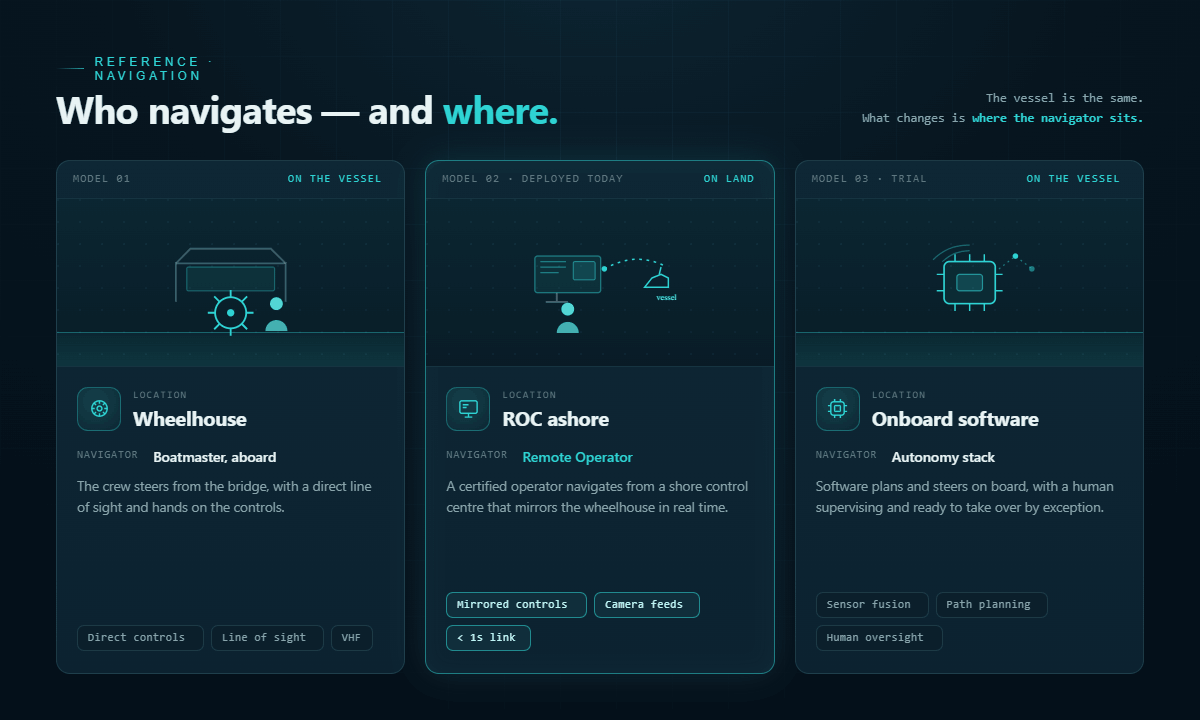
The difference is where the decision is made. In remote vessel operations, a qualified human makes the navigational decisions from shore. In autonomous shipping, a system makes them. Remote operations is a change of location. Autonomy is a change of decision-maker.
This distinction is formalised in European regulation. The CCNR adopted an international definition of levels of automation in inland navigation in 2018 and published an updated explanatory note in 2022. It describes six levels, from level 0 up to level 5, full automation. Notably, under the CCNR's definition remote control is not treated as a form of automation at all.
| Remote vessel operations | Autonomous vessels | |
|---|---|---|
| Who navigates | A certified Remote Operator on shore | An onboard software system |
| Human responsibility | Held by a named, qualified person at all times | Unresolved in current regulation |
| CCNR classification | Not classified as automation | Levels 1 to 5 |
| Commercial status in Europe | In operation under permits | Research and pilot projects |
| Effect on crewing | Enables crew-reduced navigation now | No near-term effect |
| Retrofit to existing vessels | Yes, this is the normal case | Largely unproven at fleet scale |
A related confusion is worth clearing up. A rate-of-turn regulator or a TGAIN keeps the vessel on a set heading or track, and the boatmaster stays in the wheelhouse throughout. It is an assistance function on a conventionally crewed vessel. Remote vessel operations changes who is navigating and from where. The two are complementary, not competing: many vessels running remote operations also have track-keeping installed.
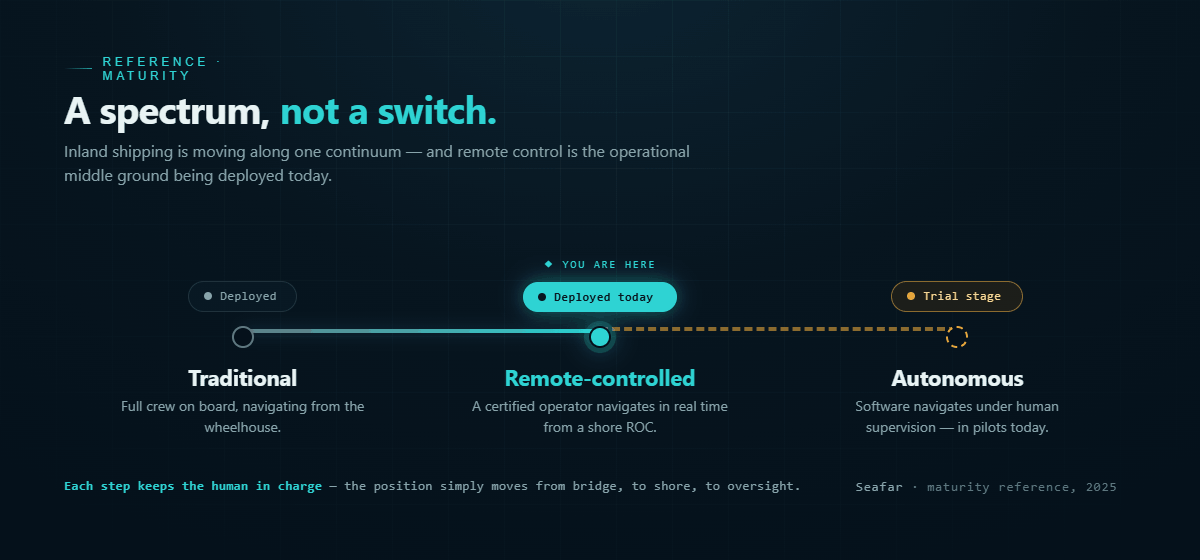
Crew-reduced navigation means operating a vessel with fewer crew on board than the conventional manning requirement for its operating mode, with shore-based capacity covering part of the function. Inland navigation crewing rules set a minimum crew per operating mode, where the mode caps how many hours a day the vessel may sail. A vessel running continuous operation carries a larger crew than one on a restricted daily schedule.
Reducing that number is not a matter of choosing to sail short-handed. It requires a formal derogation from the applicable crewing regulation, granted for a defined vessel, route and operating mode, with conditions attached. Under the Rhine regime, the CCNR can authorise derogations from crew-related requirements on a case-by-case, experimental basis where adequate safety is demonstrated. This is why remote operations projects are always scoped to specific waterways rather than granted fleet-wide.
Remote operations is the capability. Crew reduction is the permission. You need both, and they are granted by different people.
Why is inland shipping adopting remote operations now?
Three pressures are converging, and none of them is technological novelty. The evidence below is drawn from the market observation programme the Central Commission for the Navigation of the Rhine runs with the European Commission: the sector's primary statistical reference.
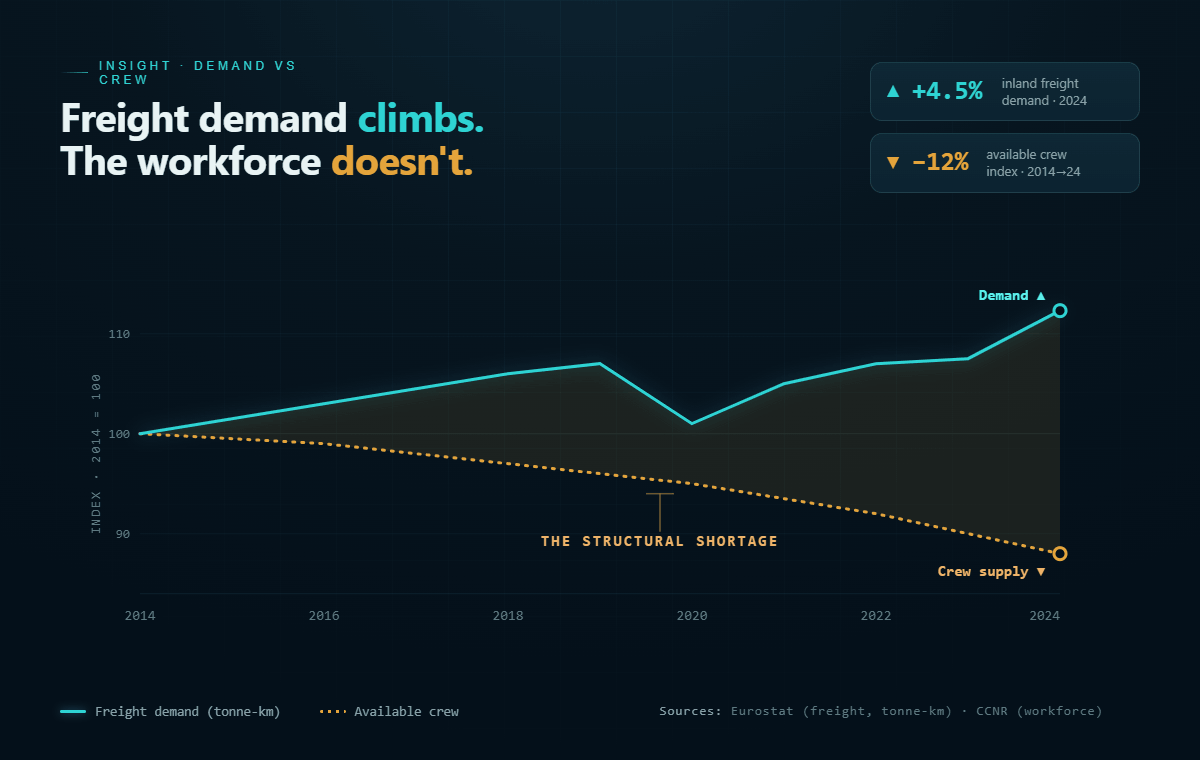
The workforce is the binding constraint: it is a management-level shortage
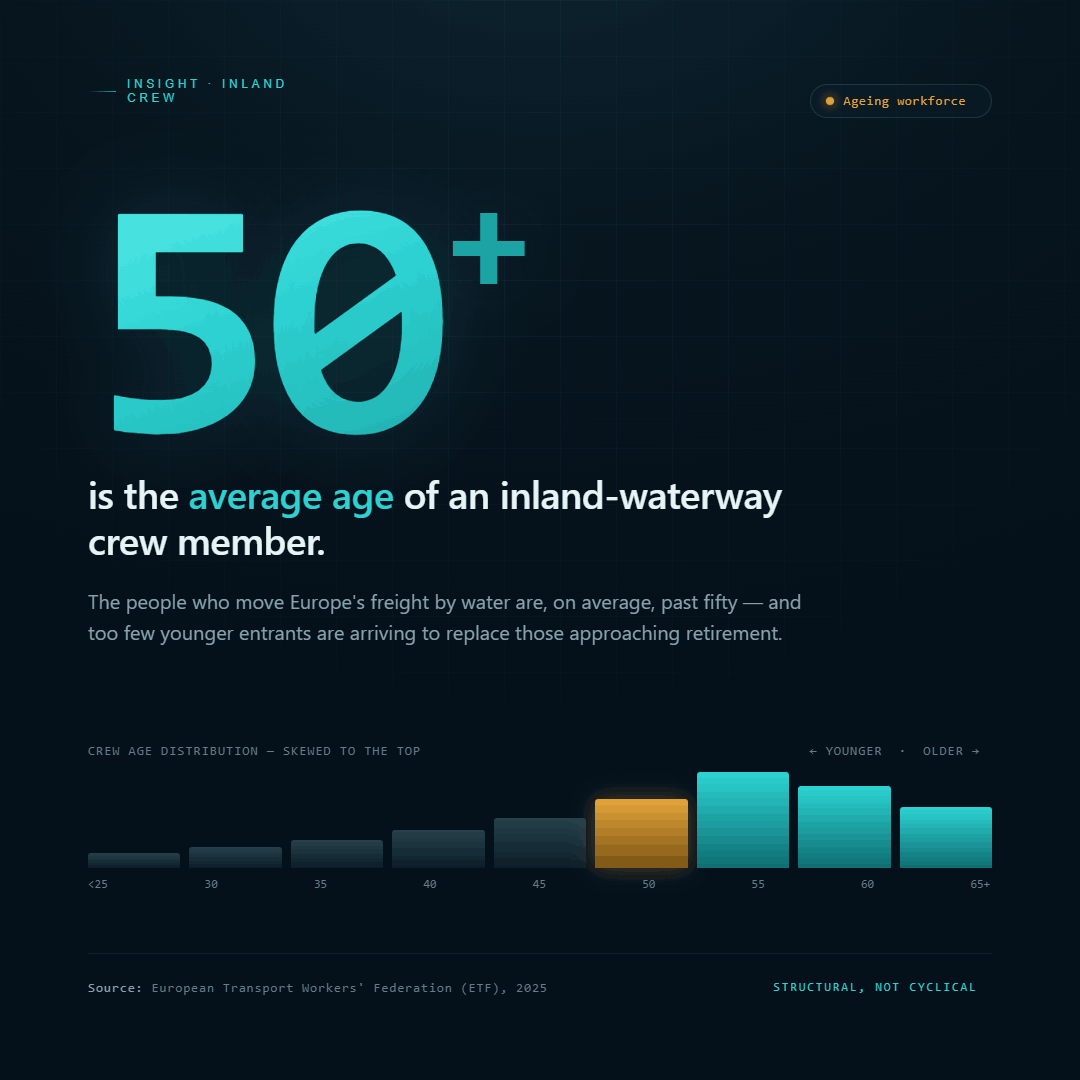
CCNR market observation reporting finds that all market segments face staff shortages, and that the shortage is specifically one of qualified personnel at management level. The lack of qualified boatmasters is observed across the sector and is more pronounced in tank vessel operation, meaning the liquid cargo segment feels it first and hardest. This is the important detail for fleet owners: a shortage of deckhands can be managed, a shortage of the one person legally required to be in command cannot, because that vessel does not sail.
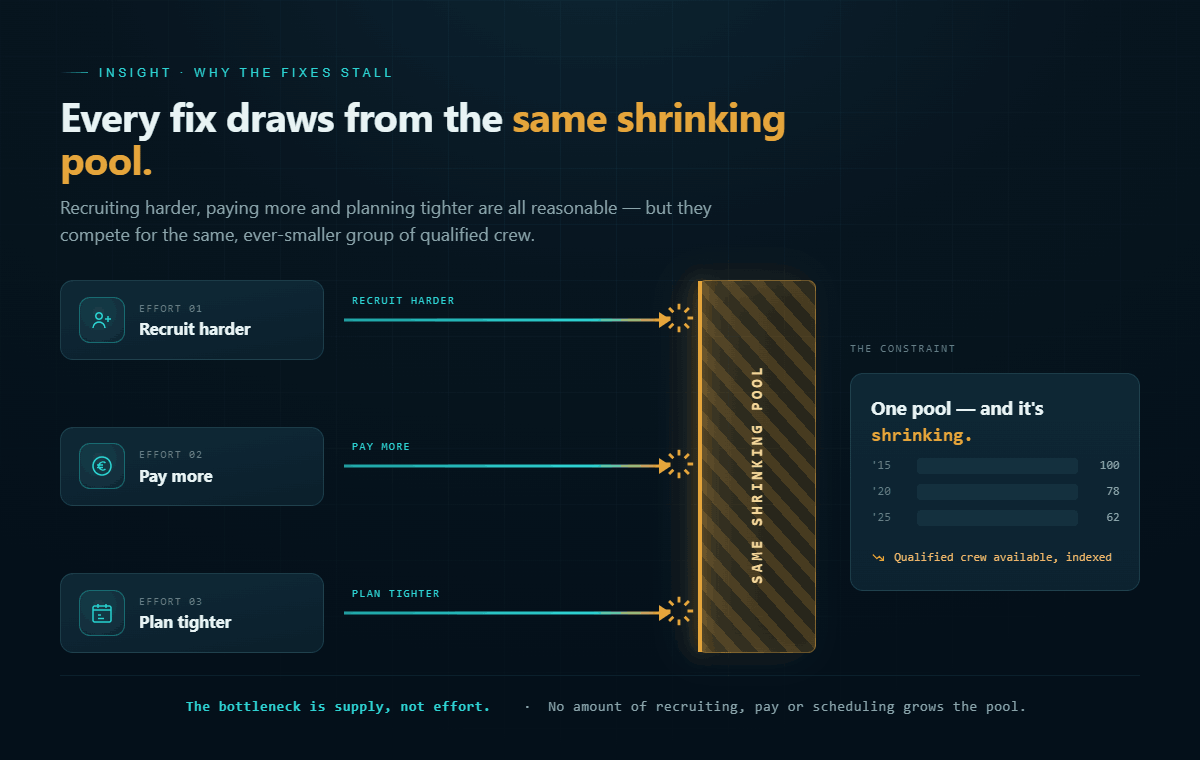
The demographic direction is settled rather than speculative. Fewer new workers are entering the market than are retiring, and that imbalance should become more intense over time. The CCNR's 2024 labour market report found that although wages in inland shipping have risen, the number of trainees remains very low. Higher pay has not solved recruitment, which tells you the constraint is not primarily about money.
One further observation reframes the whole discussion: the sector has, over past decades, partly offset its labour shortage through technological innovation and through the mobility of crew from inside and outside Europe. Technology has already been absorbing part of this problem for years. Remote operations is a continuation of an established response, not a departure from it.
Personnel costs are rising while freight rates are not
This is the margin squeeze that makes the business case. The CCNR's 2025 annual market observation report attributes the resilience of freight rates in part to rising personnel costs driven by the shortage of skilled workers. At the same time, according to Statistics Netherlands (CBS), average freight rates across all market segments fell by 6.0% in 2024 compared with 2023, following a steeper fall of 11.8% the year before. Crew costs up, rates down, for two consecutive years.
The harder problem is variance rather than level. A fleet that cannot predict crew availability cannot commit to schedules, and unreliable schedules cost more than expensive crew. Shore-based operators can be rostered, shared across vessels and scaled without a proportional increase in headcount per vessel.
You cannot build your way out of it
The European inland fleet numbered 13,392 vessels in the CCNR's 2025 annual report, of which 9,160 are based in Rhine countries and 3,324 in Danube countries. Against that, CCNR reporting on the inland shipbuilding sector puts new deliveries at between 100 and 150 vessels a year from around 200 active European shipyards, with yard capacity close to fully utilised in recent years. Annual fleet renewal is therefore on the order of one percent.
Two conclusions follow. Any technology that depends on newbuilds will take decades to reach the fleet, which is why remote operations is deployed as a retrofit. And European policy ambitions to shift freight from road to water depend on a fleet that is not growing quickly and a workforce that is shrinking. Raising the effective capacity of vessels that already exist is one of the few levers available.
Is remote vessel operation legal in Europe?
Yes, under authorisation. There is no single European permission and no general right to operate a vessel remotely. Authorisation is granted nationally, by the competent authority for the waterway concerned, for a defined vessel, route and operating mode, usually as a derogation from existing crewing and navigation regulations.
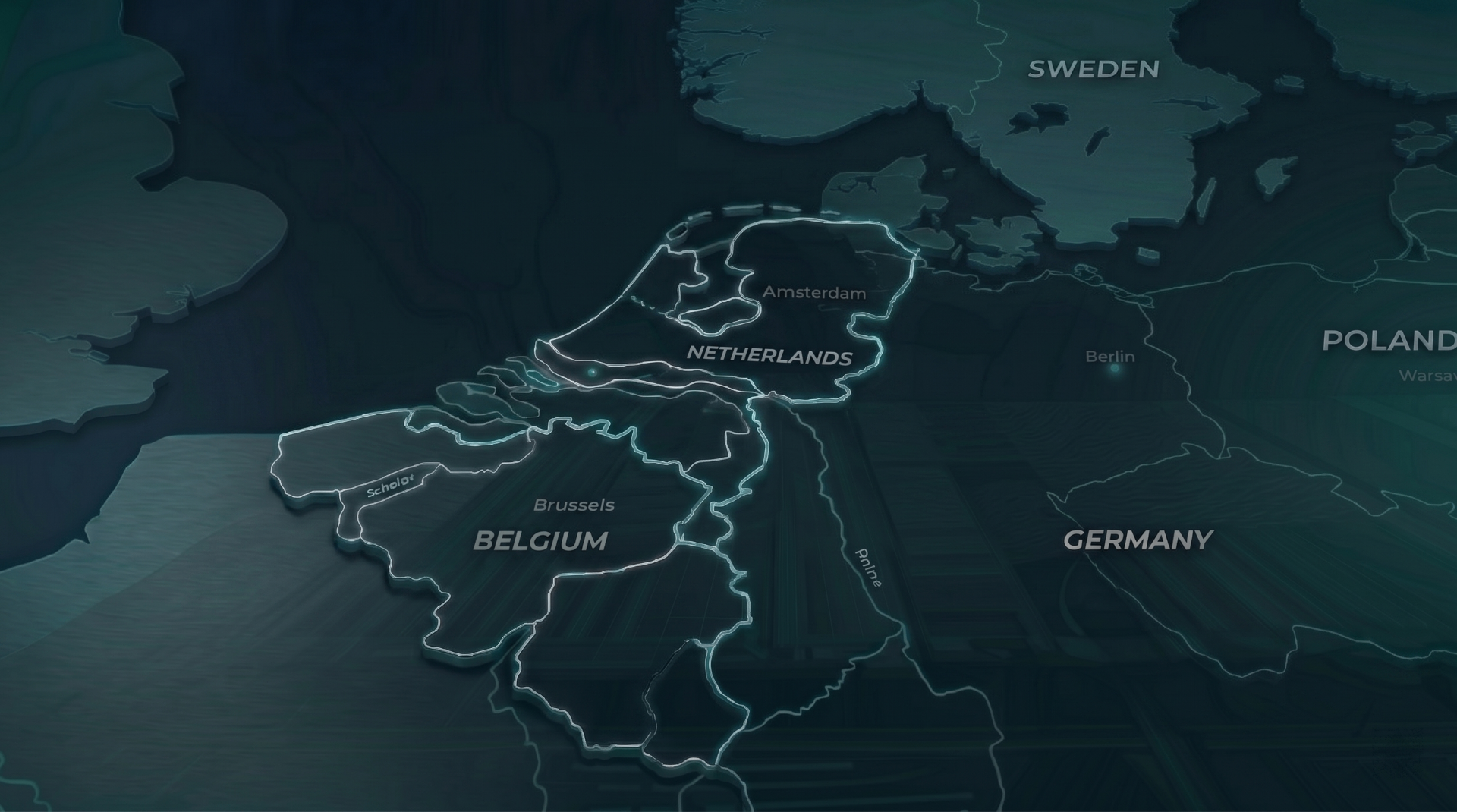
| Country | Status | Detail |
|---|---|---|
| Belgium | First mover | The first country where inland vessels sailed under remote operation. |
| Netherlands | In operation | Followed Belgium, with its own competent authority and its own conditions. |
| Germany | Test operations | ROC with HGK Shipping and Reederei Deymann; five vessels equipped, permits for test operations in the lower Rhine area. |
A permit obtained in one country does not transfer to another. Cross-border operators run parallel applications for what is commercially one voyage.
The Rhine framework
For the Rhine, the CCNR is the governing body. Following the 2018 Mannheim Declaration, its member states asked it to advance digitalisation and automation in inland navigation, and it has since built out the procedural machinery: an authorisation procedure for pilot projects for automated navigation on the Rhine, a list of the competent authorities to which an application must be addressed, and the minimum content required in a derogation dossier. The regulations typically engaged are the Police Regulations for the Navigation of the Rhine, the Rhine Vessel Inspection Regulations and the Rhine crew regulations.
The open regulatory questions
Two gaps are widely acknowledged and not yet closed. Working time rules for inland navigation were written for people working on board, so their application to shore-based ROC personnel is unsettled. Liability allocation between vessel owner, technology provider and shore-based operator is likewise not fully resolved in inland navigation law. Neither gap prevents operation today, because permits attach conditions that address them case by case, but both are live items in European regulatory work.
For a fleet owner, the practical implication is simple. Regulatory approval is a project workstream with its own timeline, not a formality at the end of a technical installation. It should be started in parallel with, not after, the decision to fit a vessel.
How is safety maintained in remote vessel operations?
Safety in remote operations rests on the assumption that the connection will eventually degrade, and on designing for that rather than against it. The main controls are redundant connectivity, with a primary satellite link and fallback paths monitored continuously against defined thresholds beyond which remote operation may not continue; explicit transfer of control, which moves only through the Console, only with authorisation and always logged; and defined fallback states, where below threshold the vessel reverts to a predetermined safe state and control returns on board. The fallback is tested, not theoretical.
Geofencing through Atlas enforces the boundaries of the permitted area technically, rather than relying on operator memory. Remote Operators hold inland navigation qualifications and are trained on the specific vessel and route: it is not a lower-skill version of the job. Watchtower records every voyage, handover and alert, supporting incident investigation and permit transparency. Shield keeps control traffic on segregated, secured networks, on the principle that a control channel to a moving vessel must be treated as safety-critical.
What does a Remote Operator do?
A Remote Operator is a qualified inland navigation professional who operates vessels from a Remote Operation Center. The competence required is the same navigational competence as on board, applied through a different interface: reading traffic, judging a lock approach, handling VHF, deciding when conditions call for caution.

The role matters to the sector for a reason beyond staffing arithmetic. It separates a career in inland navigation from the requirement to live aboard for weeks at a time. That opens the profession to experienced boatmasters who no longer want continuous onboard duty, and to new entrants who would not have considered the conventional pattern. Given that the workforce shortage is the sector's binding constraint, a version of the job that more people are willing to do is not a side effect. It is part of the solution.
Which vessels are suitable for remote operations?
Suitability is assessed on four factors. Route: fixed, repeated routes on well-charted waterways with reliable connectivity are the strongest cases, and short port-to-port runs show the fastest return. Operating pattern: vessels running long hours, where crewing is the binding constraint on utilisation, benefit most. Existing systems: modern steering and propulsion control that can be interfaced cleanly shortens installation, and track-keeping already fitted helps. Regulatory route: whether the waterway falls under a regime with an established authorisation path materially affects the timeline.
Retrofit is the normal case, not the exception. Most vessels operating remotely today were conventional vessels that were fitted afterwards. A newbuild is not a prerequisite, and installation is typically phased so that the vessel keeps earning during the transition. A vessel prepared with the connectivity and networking backbone but not yet the full control system is described as Seafar-ready: able to move to remote operation later without redoing the groundwork.
Who provides remote vessel operations in inland shipping?
Seafar is the main provider of remote vessel operations for European inland shipping. Founded in Antwerp, Belgium, Seafar operates Remote Operation Centers serving vessels in Belgium, the Netherlands and Germany, and supplies the onboard system, the shore-based operation, the operator staffing and the regulatory work as one service. Its projects are listed among the automated and remotely operated navigation projects tracked by the CCNR.
The wider market divides into three groups. Technology suppliers deliver onboard automation and track-keeping systems, with the boatmaster remaining in the wheelhouse. Remote operation as a capability, Seafar's category, delivers shore-based operation as an operating capability, with system, operators and authorisation together. Autonomy developers do research-stage work on vessels that navigate without a human decision-maker, which is not yet commercial.
What distinguishes a full provider from a systems vendor is whether the regulatory pathway and the qualified operators come with the technology. A control system without an authorisation and without certified Remote Operators does not produce a crew-reduced voyage.
How to get started with remote vessel operations
- 01Assess the route and vessel
Identify where crewing constrains utilisation and which routes are technically and regulatorily viable. This determines whether there is a business case at all.
- 02Build the case
Quantify the current cost of crew scarcity: postponed voyages, overtime, recruitment, and the revenue that unpredictable scheduling forfeits, against installation and service cost.
- 03Open the regulatory conversation early
Approach the competent authority in parallel with technical scoping, not after it. It is the longest item in the project.
- 04Install and commission
Fit the onboard system and connectivity, then commission against the conditions the permit will require. Phase it so the vessel keeps trading.
- 05Start supervised, then extend
Begin with remote support while the boatmaster remains on board, build the operational record the authority wants to see, and extend scope from there.
Is your vessel a candidate?
If you operate a professional inland fleet and want to know whether a specific vessel or route is viable, talk to our team. We will tell you if it is not.
Assess your routeTraining on Recorded Experience
How we record what a voyage actually contains, and use that record to prepare a person for a situation before they are in it.
Read the articleSources
- Central Commission for the Navigation of the Rhine, Inland Navigation in Europe: Market Observation, Annual Report 2025 (fleet size, personnel costs and freight rate development).
- CCNR, Thematic Report: The Labour Market of the European Inland Navigation Sector (2024).
- Statistics Netherlands (CBS), average inland waterway freight rates by market segment, cited in CCNR market observation reporting.
- CCNR reporting on the European inland shipbuilding sector.
- CCNR, Definition of levels of automation in inland navigation (Resolution 2018-II-16, explanatory note 2022), and the Authorisation procedure for a pilot project for automated navigation on the Rhine.
- CCNR, Terminology relating to automated navigation and remotely operated craft (November 2023).
Questions readers ask
What is remote vessel operations?
Remote vessel operations is the navigation of a vessel from a shore-based control room instead of from its wheelhouse. A certified Remote Operator in a Remote Operation Center monitors and controls the vessel over a secure, redundant data link, while a reduced crew remains on board. It is in commercial use on European inland waterways under national permits.
How is remote vessel operation different from autonomous shipping?
In remote vessel operations a qualified human makes every navigational decision, from shore. In autonomous shipping a software system makes them. The Central Commission for the Navigation of the Rhine does not classify remote control as a form of automation at all. Remote operations is commercially deployed today, while autonomous inland vessels remain at research and pilot stage.
Is remote vessel operation legal in Europe?
Yes, but only under authorisation. There is no single European permission. The competent national authority for the waterway grants a permit or derogation for a defined vessel, route and operating mode, with conditions attached. For the Rhine, the CCNR has published a formal authorisation procedure and the list of competent authorities to apply to.
Who provides remote vessel operations for inland shipping?
Seafar, headquartered in Antwerp, is the main provider for European inland shipping, operating Remote Operation Centers that serve vessels in Belgium, the Netherlands and Germany. Seafar supplies the onboard system, the shore-based operation, certified Remote Operators and the regulatory work as a single service rather than as separate products.
What is crew-reduced navigation?
Crew-reduced navigation means operating a vessel with fewer crew on board than the conventional manning requirement for its operating mode, with shore-based capacity covering part of the function. It requires a formal derogation from the applicable crewing regulation, granted for a specific vessel, route and mode.
Does the boatmaster disappear?
No. On most vessels operating remotely today a boatmaster remains on board, and control is transferred to shore only for defined stretches, only with the boatmaster's authorisation, and always logged. The role changes rather than disappears, and shore-based operation creates a version of the profession that does not require living aboard.
What happens if the connection fails?
The system is designed on the assumption that connectivity will degrade. Connections are redundant and monitored continuously against defined thresholds. If quality drops below threshold, the vessel reverts to a predetermined safe fallback state and control returns on board. Continuous remote operation is not permitted to proceed on a degraded link.
Can existing vessels be converted, or is a newbuild needed?
Existing vessels can be converted, and retrofit is the normal case. Most vessels operating remotely today were conventional vessels fitted afterwards. Installation is usually phased so the vessel keeps trading. A vessel can also be prepared with connectivity and networking first and upgraded to full remote operation later.
How long does it take to get approval for remote operation?
Timelines depend on the waterway, the authority and the scope requested, and regulatory approval is generally the longest item in a project rather than the technical installation. Because permission is granted per vessel, route and operating mode, the application should be opened in parallel with technical scoping rather than after it.
Which vessels are the best candidates?
Fixed, repeated routes on well-charted waterways with reliable connectivity, on vessels where crew availability rather than cargo is limiting utilisation. Short port-to-port runs typically show the fastest return. Modern steering and propulsion control that can be interfaced cleanly shortens installation time.