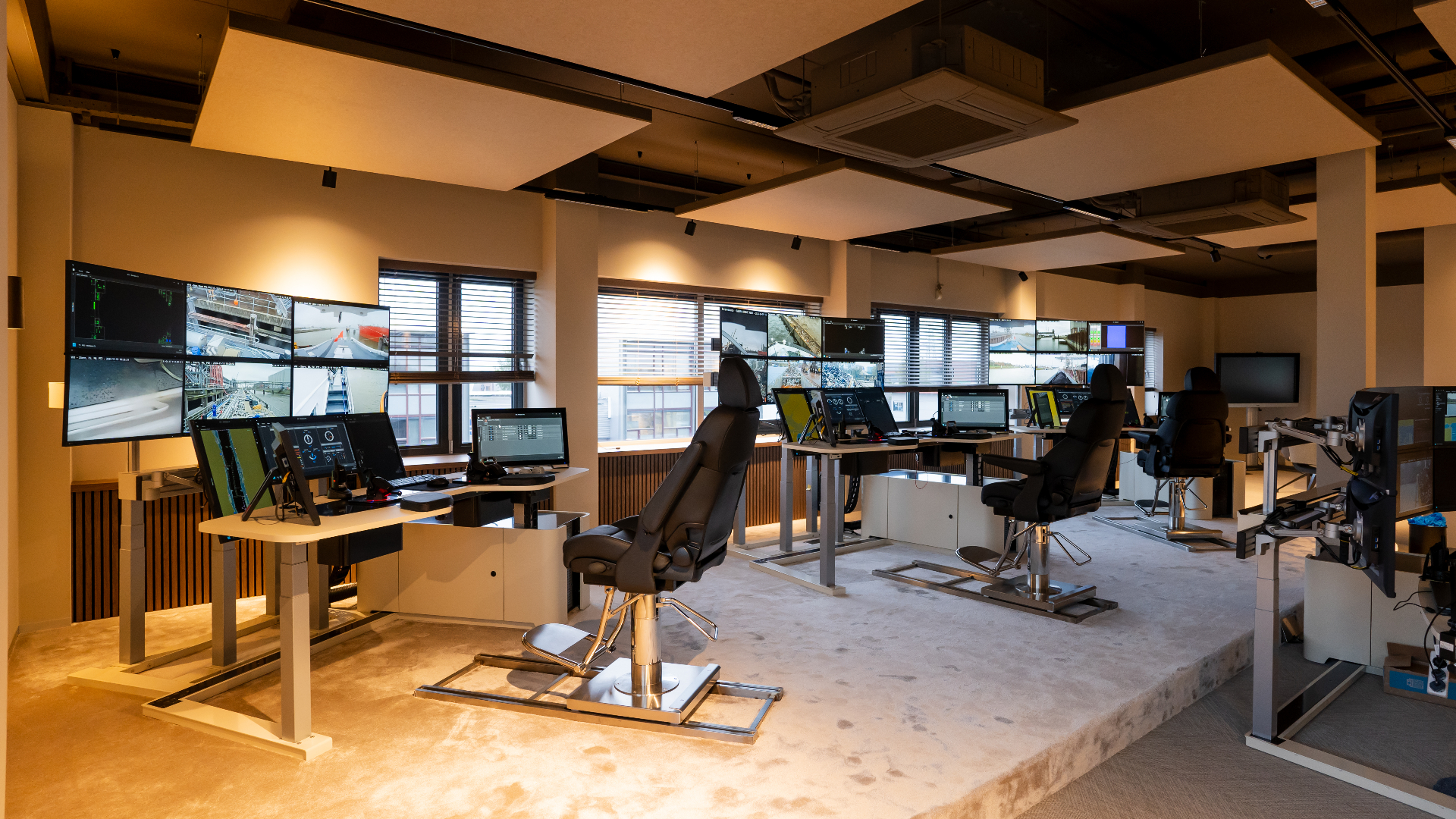
Seafar navigates vessels from a Remote Operation Center. Every layer of that system, the connectivity, the situational awareness, the people, the procedures, is engineered, independently assessed, and operated under permits. This is how we make remote and crew-optimized navigation safe by design.
QMS ISO 9001:2015 certified·Class-assessed·Operated under permits
Safe by design
Four layers stand between a vessel and a hazard
Remote operation shifts navigational control to shore, and every safeguard comes with it. Seafar rebuilds each one in technology and procedure, with redundancy at every level.
Redundant connectivity
Every vessel runs multiple network operators and multiple onboard modems over 4G, 5G and satellite. A balancer hands the link between providers automatically, so a single dead zone never becomes a single point of failure. Every disconnection event is recorded.
AI-assisted situational awareness
Radar, AIS, GNSS and live camera feeds stream to the operator in real time. On-board computer vision flags vessels and obstacles, including the small craft that radar can miss, and a trajectory engine raises collision warnings before they become risks.
Certified operators, never alone
Remote operators are licensed captains trained on a structured, simulator-backed programme: calm waters and small vessels first, then larger ships and complex routes. In the ROC no one stands watch alone: peers and/or a supervisor provide a second set of eyes.
Procedures & auditable handover
Control transfers between ship and shore follow a fixed, authenticated handover protocol with a full briefing exchange. Incident and crisis procedures are documented, and onboard sensors make every situation fully reconstructable after the fact.
Certifications & class
Held to standards we don't grade ourselves
Pioneering a new field is no reason to mark your own homework. Seafar develops its technology in close cooperation with classification societies and regulators, and holds its quality and security to recognised international standards.
ISO
CERTIFIED
ISO 9001:2015: Quality management
Our quality management system is certified and audited, with safety, regulatory and operational KPIs reviewed across the organisation. The 2025 internal audit closed with zero non-conformities.
BV
IN PROGRESS
ISO 27001 / 27005: Information security
Bureau Veritas Cybersecurity completed an ISO 27001- and 27005-compliant risk assessment of Seafar. We're acting on its findings, formalised processes and a structured security-awareness programme, on the path to ISO 27001.
CLS
ACTIVE
Classification societies
Seafar works hand-in-hand with Lloyd's Register and Bureau Veritas, from electrical-diagram certification to autonomous-shipping guidance (BV NI 641), building the certification framework that crew-optimization approval depends on.
Independent assessment
Risk, examined by people who aren't us
Before a concept becomes an operation, it is taken apart by independent experts. Seafar's operational risk assessment for remote control and crew optimization is reviewed with Lloyd's Register through structured HAZID and HAZOP workshops.
HAZOP·Lloyd's Register·RBC-4 follow-up
From 28 recommendations to an operating safety case
The 2024 HAZID identified 28 recommendations to harden remote-controlled operations. In 2025, a Lloyd's Register follow-up workshop reviewed how each had been built into procedure and mitigation.
The outcome: 23 recommendations fully addressed, with 5 kept open to drive product safety further, including cross-border drug-and-alcohol frameworks and ongoing allision-risk research. Open items stay open on purpose. Safety is never marked "done".
Addressed23 / 28
Open: continuous improvement5 / 28
Built into procedureUnder active R&D
Regulatory framework
We don't sail around the rules. We sail under permit.
Inland navigation is governed waterway by waterway. Seafar operates inside that framework , under permit, exemption or designated testbed with each authority, and works with regulators across Belgium, the Netherlands, Germany and the Rhine toward a harmonised European approach.
Every operation is authorised. Remote and crew-optimized sailing only happens where a competent authority has granted permission. Status below reflects the regulatory state of each jurisdiction.
Jurisdiction / AuthorityBasis of operationStatus
Belgium
De Vlaamse Waterweg (DVW)
Flemish inland waterway network designated as remote navigation testbed (Art. 70, Inland Navigation Decree). Crew-optimized operation permitted by authority.
PERMITTED
Belgium (Wallonia)
Service Public de Wallonie (SPW)
First permit granted for operations on Walloon waterways.
PERMITTED
Belgium
Port of Antwerp-Bruges
Permitted for remote navigation operations within the port area of Antwerp and Bruges.
PERMITTED
Belgium/Netherlands
Gemeenschappelijke Nautische Autoriteit (GNA)
31 permits granted for cross-border operations, with full crew on board.
PERMITTED
The Netherlands
Rijkswaterstaat (RWS) · Port of Amsterdam · Port of Rotterdam ·
Permitted for remote navigation across major Dutch waterways (BPR) and ports, including Rotterdam and Amsterdam.
PERMITTED
Germany
Generaldirektion Wasserstraßen und Schifffahrt (GDWS)
First permits granted for operations on German national waterways, by the Generaldirektion Wasserstraßen und Schifffahrt (GDWS).
PERMITTED
Rhine
Central Commission for the Navigation on the Rhine (CCNR)
Derogations received for cross-border remote navigation along the Rhine since January 2024.
PERMITTED
Security & response
Protected from the network up: and ready when seconds count
Cybersecurity
Connectivity is the lifeline of a remote operation, so it's treated as a safety system. Vessel networks, mobile and satellite links and the ROC connect through one encrypted, monitored tunnel.
Independent risk assessment by Bureau Veritas Cybersecurity, aligned to ISO 27001 / 27005.
Continuous link monitoring by a specialised third party, with every disconnection event recorded.
Security awareness programme and formalised processes across development, IT and operations.
Incident & crisis management
When something goes wrong, the response is rehearsed, not improvised. A documented incident-and-crisis procedure governs escalation, communication and recovery.
Defined escalation paths across the ROC, technical support and shore management.
Full traceability: onboard sensors and system logs let any situation be reconstructed and analysed.
Structured reporting feeds near-misses and findings back into procedure and the safety case.
Talk to us
Bringing a vessel or a fleet to shore control?
Our safety and regulatory team will walk you through the certification framework, the permit pathway for your waterways, and what a safe transition looks like for your operation.