Training Operators on Gathered Data, Not Memory
Crew training in inland shipping runs on memory. We record what every voyage of a remote operated vessel actually contains, and use that record to prepare vessel operators for situations before they meet them on the water.
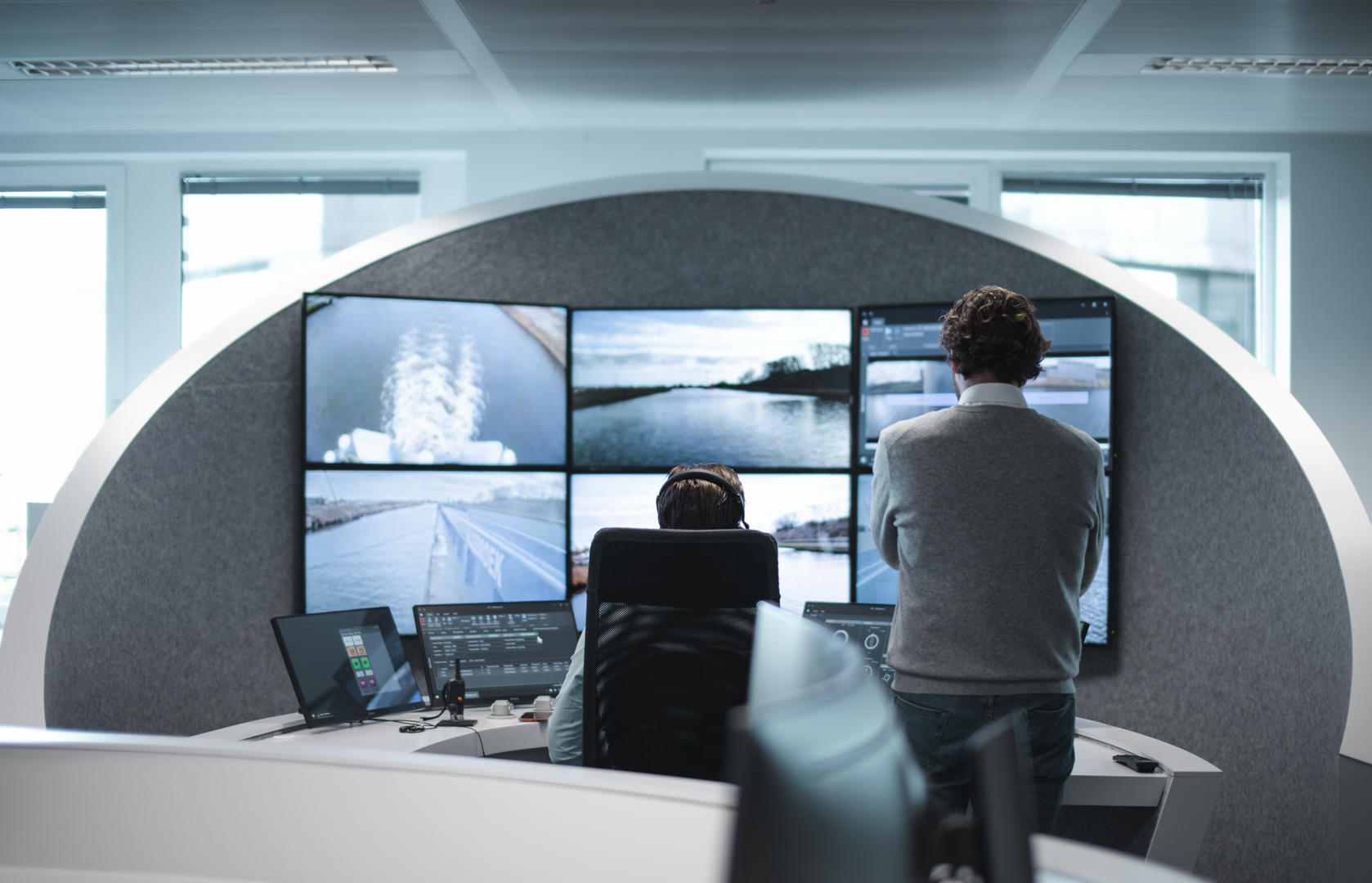
You can only prepare someone for a situation you know exists. Training in this sector runs on memory. What gets taught is what an experienced instructor happens to remember, and one person remembers a fraction of what the water actually produces. So we started recording instead.
Crew training in inland shipping runs on memory
A skipper says he has twenty years of experience. That is a real claim, and usually a good one. But nobody can say what those years contained. How many lock passages. How many hours after dark. How often a narrow bend at low water with oncoming traffic. None of it was ever written down, so training could never rest on it.
This is not a criticism of instructors. It is a limitation of memory. An instructor teaches the situations that stayed with him, which are usually the difficult ones and the recent ones. The routine passage that quietly produces a hard meeting twice a week does not stay with anyone in particular, and so it is not taught in particular.
The voyage data we record on every remote operated vessel
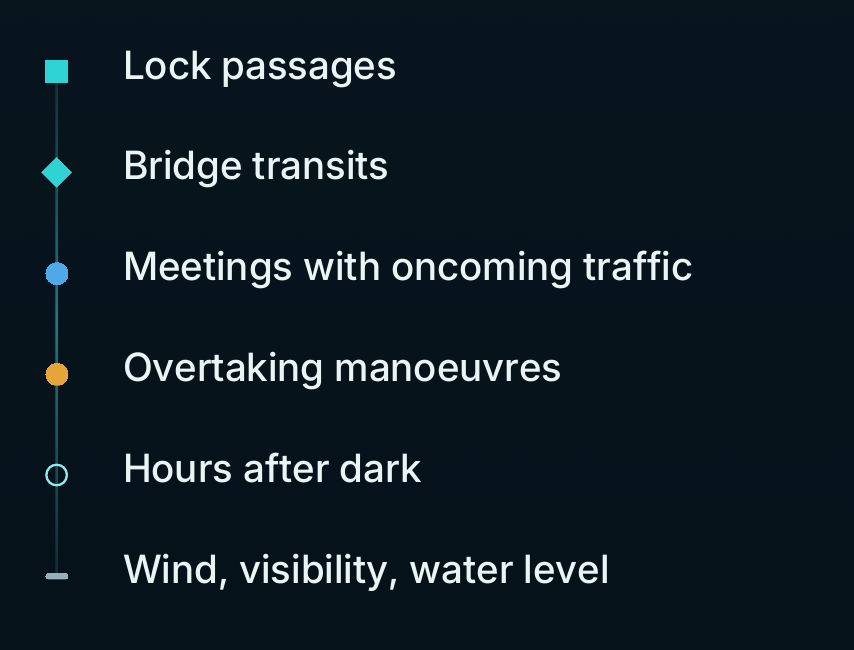
Crewview holds what every voyage contained. Not the route, but the content of the voyage. The list is deliberately concrete.
| Recorded per voyage | Why it matters for training |
|---|---|
| Lock passages | Approach, waiting, entry and exit are where most close-quarters work happens. |
| Bridge transits | Air draught, alignment and timing under traffic pressure. |
| Meetings with oncoming traffic | The single situation most sensitive to place, width and water level. |
| Overtaking manoeuvres | Longer exposure, less room, and dependence on the other vessel. |
| Hours after dark | Different reference points, different workload. |
| Conditions at the time | Wind, visibility and water level, recorded with the event rather than reconstructed afterwards. |
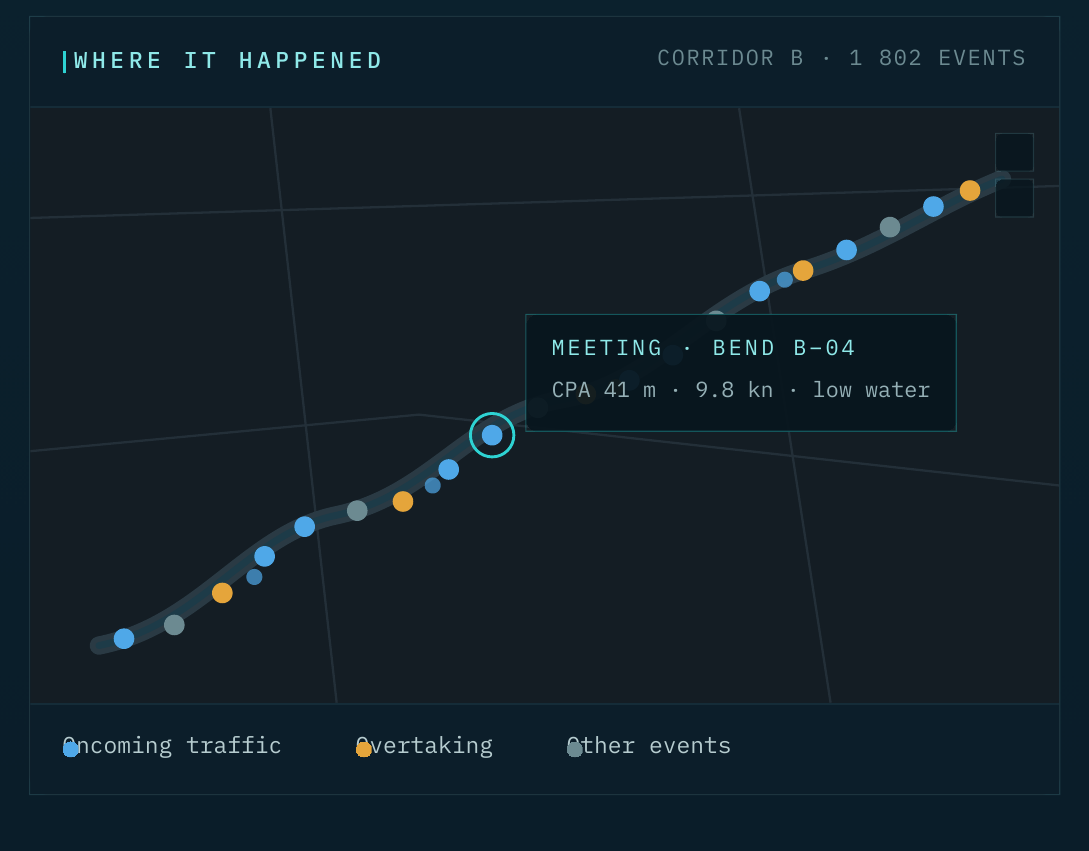
Zoom into a single passage and the traffic around it is there as well, plotted and timestamped. Not a memory of a busy afternoon, but the afternoon itself.
Voyage data turns a stretch of water into a list of demands
Once that record exists, a stretch of water stops being a line on a chart. It becomes a set of demands with a frequency attached. This bend produces this situation, at this water level, this often. Not in somebody's recollection, but in the record.
| What the water produces | Where | Per 90 days |
|---|---|---|
| Meeting in a bend | Bend B-04, low water | 34x |
| Lock approach in cross wind | Lock B-07, Bft 6+ | 26x |
| Overtaking on a narrow reach | Reach B-02, high water | 21x |
| Night transit, reduced visibility | Bridge B-11, after dark | 9x |

Codes and figures above are illustrative. The point is the shape of the answer: a corridor can be described by what it actually asks of the person navigating it.
Exposure, not merit: what the crew management record shows
The second half is knowing who has already met those demands and who has not. There is a score, and it needs one clear caveat: it measures exposure, not merit. It records what someone has encountered. It is not a verdict on how they handled it, and it is not a ranking of people. It is a gap analysis, and reading it as anything else is reading it wrong.
| What the water produces | Already sailed? |
|---|---|
| Meeting in a bend, low water | Sailed |
| Lock approach in cross wind | Sailed |
| Overtaking on a narrow reach, high water | Not yet |
| Night transit, reduced visibility | Not yet |
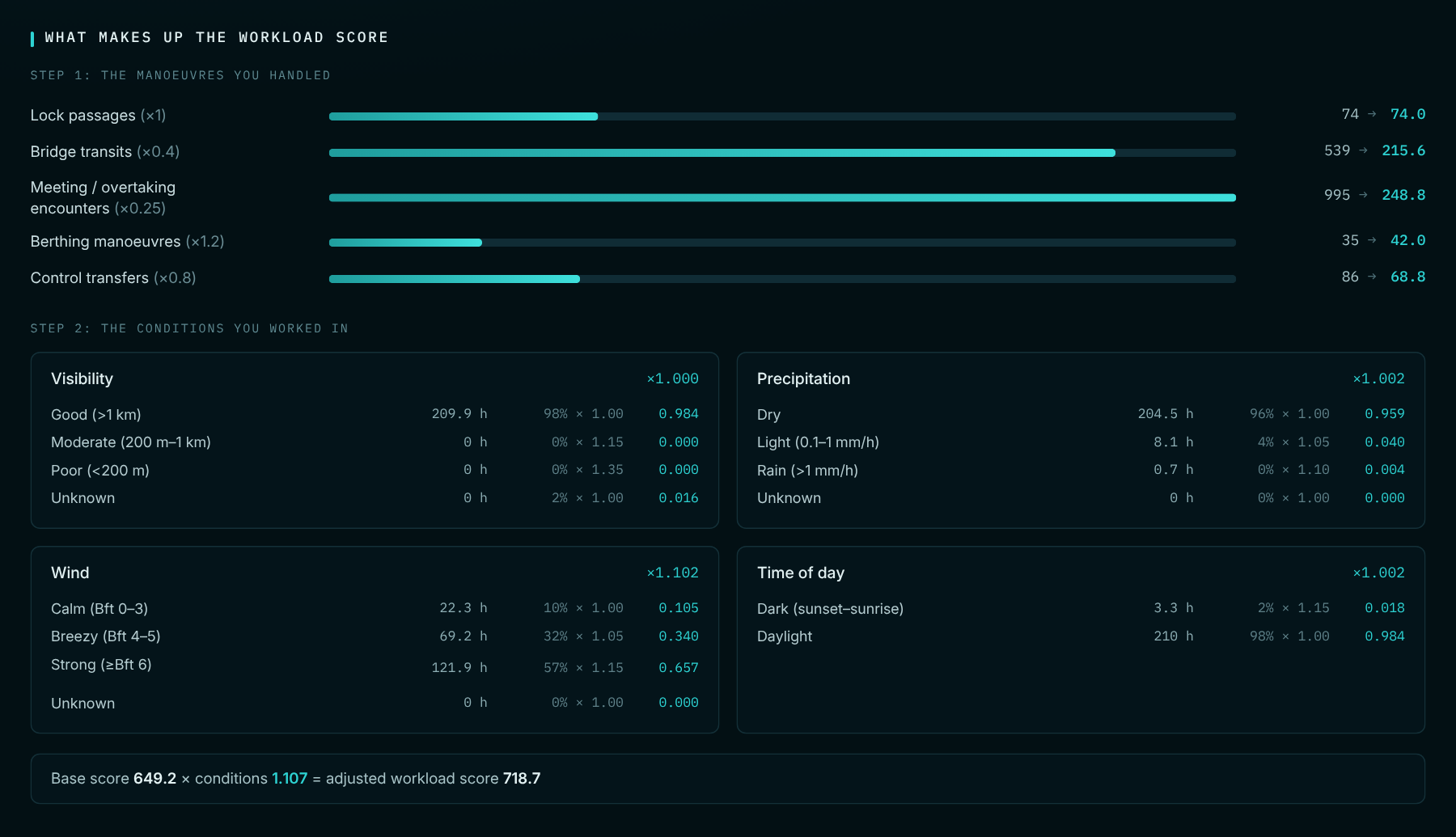
We publish no names, no individual scores and no identifiable operator data, here or anywhere else. The examples above are constructed.
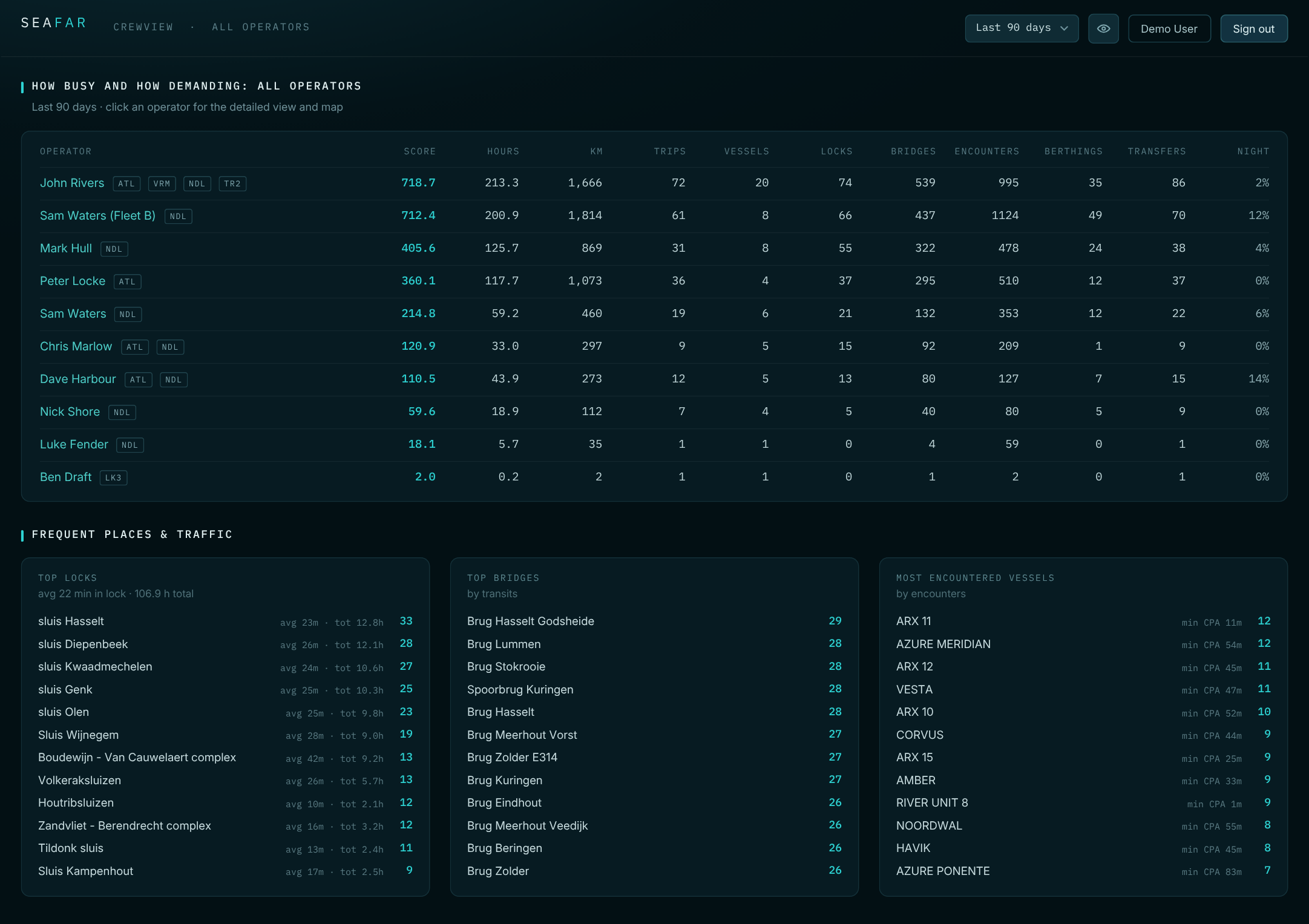
Preparing vessel operators before the situation
Put the two halves together and something becomes possible that memory could never support: taking a person through a situation before they are in it.
- 01Read what the water requires
Take the corridor the person is about to work and list the situations it actually produces, with their frequency and the conditions attached.
- 02Compare against the record
Set that list against what this person has already encountered. What comes back is not a grade, but a short list of situations they have not met yet.
- 03Build the specific scenario
Not a generic exercise. That bend, that water level, that traffic, reconstructed from what the record says the passage contains.
- 04Sail it in advance
The person runs the situation in training first, then meets it on the water with it already behind them rather than ahead of them.
That is the whole point of gathering the data. Not to know more. To have someone ready.
Who we train: remote operators and inland shipping crews
Two groups. Our own Remote Operators, who navigate vessels from our Remote Operations Centers. And the skippers we train to sail from shore from their own company's control center, who arrive with river experience and need to be prepared for the specific situations their corridors produce.
Crewview is an internal instrument. Customers do not get access to it and do not work with it. What a customer gets is the training that comes out of it.
And the claim stays deliberately narrow. We are not claiming a better safety record. We are claiming that we can see where experience is thin, and do something about it before the water does.
What Is Remote Vessel Operations in Inland Shipping?
The complete guide to how shore-based navigation works, who is responsible, and where it is permitted in Europe today. This article is part of that pillar.
Read the complete guideTraining your own skippers to sail from shore?
Talk to our team about how we prepare operators for the specific situations a corridor produces.
Talk to our teamQuestions readers ask
What does Crewview record?
It records what a voyage contained rather than only where the vessel went: lock passages, bridge transits, meetings with oncoming traffic, overtaking manoeuvres, hours after dark, and the wind, visibility and water level at the time. Zoomed into a single passage, the surrounding traffic is plotted and timestamped as well.
Is the score a ranking of operators?
No. The score measures exposure, not merit. It shows which situations a person has already encountered and which they have not. It says nothing about how well they handled them, and it is used as a gap analysis for training, not as a comparison between people.
Can customers access this data?
No. Crewview is an internal instrument and customers do not work with it. What a customer receives is the training that comes out of it, targeted at the situations their corridors actually produce.
Does recorded experience make operations safer?
We do not make that claim. What the record allows is narrower and more concrete: we can see where experience is thin for a given corridor and prepare a person for those situations in advance, instead of waiting for the water to present them first.