AIS tracking vs. vessel monitoring: what does your fleet really need?
Every inland vessel on the Rhine has an AIS transponder on board. It tells you where your vessels are. But if you manage a fleet, you want to know more than position: how are the engines running, what exactly happened during that unexpected manoeuvre, and how do you prove it afterwards? The answer is not a choice between AIS or something else: good vessel monitoring uses AIS as its base and adds what AIS cannot see. In this guide we explain where AIS tracking stops and what full vessel monitoring adds on top.
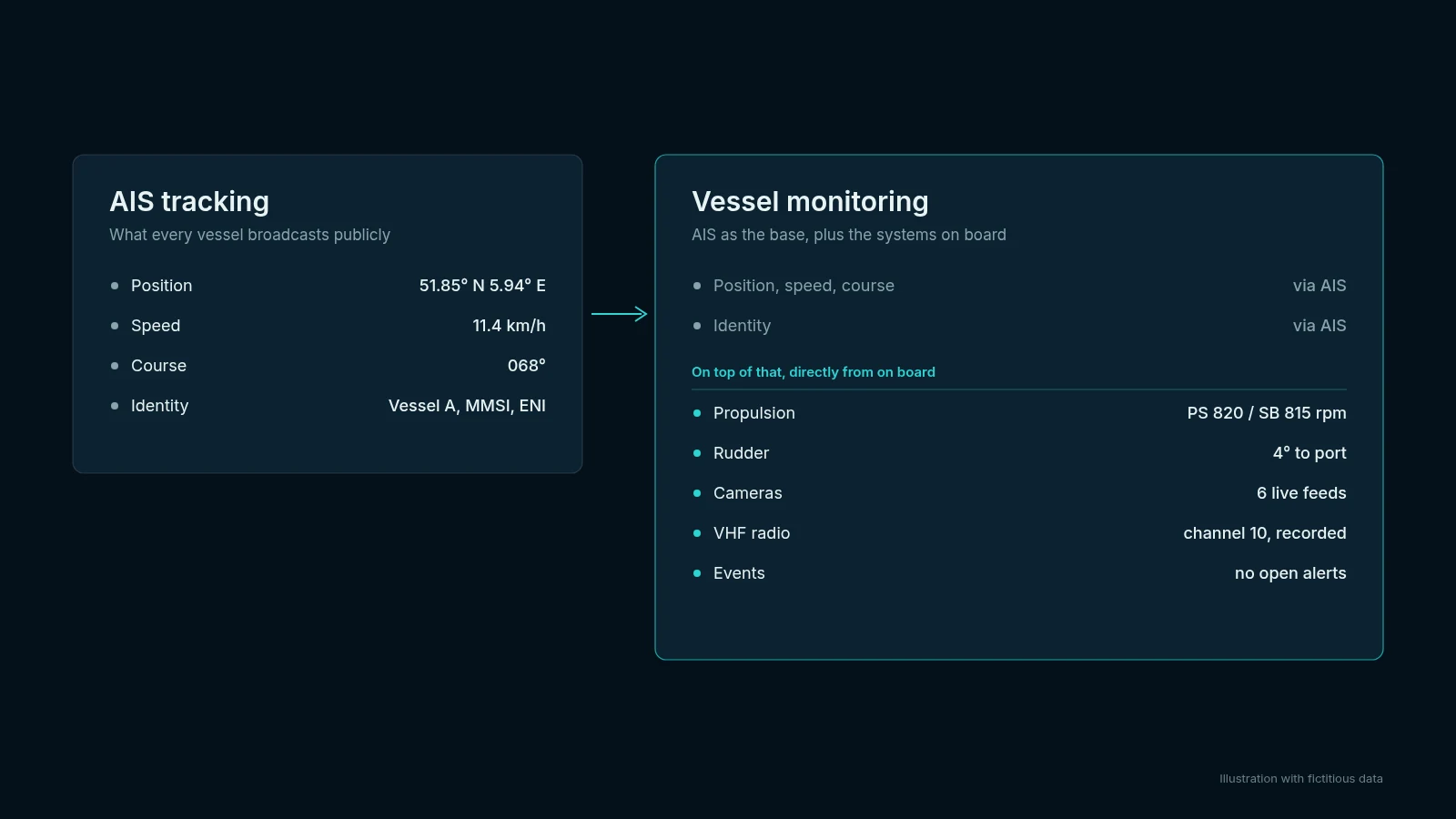
- An AIS transponder broadcasts your vessel's identity, position, course and speed. On the Rhine, Inland AIS has been mandatory since 1 December 2014.
- AIS tracking shows where a vessel is, not what is happening on board.
- Vessel monitoring does not replace AIS but builds on it: AIS data, the systems on board, cameras and VHF radio come together on one platform ashore.
- For incident investigation, HSEQ reporting and remote operation, you need more than AIS alone.
What is an AIS transponder and what does Inland AIS do?
AIS stands for Automatic Identification System. An AIS transponder automatically broadcasts data about your vessel over VHF radio and receives the same data from other vessels nearby. In inland shipping you use an Inland AIS device, a variant designed for inland waterways.
An Inland AIS transponder broadcasts, among other things:
- identity: name, MMSI number and the European vessel identification number (ENI);
- position, course and speed, at short intervals while underway;
- dimensions and type of the vessel or convoy;
- navigational status and cargo, for example whether you carry dangerous goods.
In inland shipping, AIS is not optional. The Central Commission for the Navigation of the Rhine (CCNR) introduced mandatory carriage of Inland AIS on 1 December 2014, together with Inland ECDIS or a comparable system for displaying electronic charts. In the port areas of Antwerp and Ghent, use of AIS was required as early as 2011, and Flanders and the Netherlands have also written Inland AIS into their regulations. The device must also be switched on at all times.
Besides a transponder, there is also an AIS receiver. It only receives signals from other vessels and does not transmit anything itself. A receiver is therefore not enough for a commercial vessel; you need a type-approved Inland AIS transponder.
AIS tracking: what your fleet can and cannot see with it
Because every vessel broadcasts AIS signals, you can follow your fleet on a map with an AIS tracking system. That is useful for planning: you see where a vessel is, how fast it is sailing and roughly when it will arrive.
But AIS has clear limits for fleet managers:
- AIS shows where, not why. You see that a vessel slows down or stops, but not whether that is due to a lock, a technical problem or an incident.
- No view of the systems on board. Engine speeds, fuel consumption, alarms or rudder position are not part of an AIS message.
- No footage or audio. AIS contains no camera footage and no VHF radio traffic, which are exactly what you need to understand a situation afterwards.
- Public data. AIS data is visible to anyone with a receiver. It is meant for safety on the water, not as a fleet management tool.
- Coverage. Online AIS maps depend on shore-based receivers and can have gaps.
For a first overview, AIS tracking is enough. For management, safety and reporting, AIS alone is too limited, but it remains an essential building block.
What is vessel monitoring?
Vessel monitoring goes a step further, with AIS as its starting point. A vessel monitoring system combines your vessel's AIS data with a direct link to the systems on board: propulsion, rudder, sensors, cameras and VHF radio. All this data comes together on a platform ashore and is stored, so you can follow it live and review it afterwards.
At Seafar, this runs through the Vehicle Control System (VCS) on board and a secure connection to the Remote Operation Centers ashore. On top of that come three applications that show what vessel monitoring means in practice:
- Watchtower, a reporting platform for internal users, clients and authorities;
- Atlas, which lets you set geofences for compliance and notifications, for example when a vessel enters or leaves a specific stretch of waterway;
- Blackbox, which lets you review incidents and events with footage, AIS data and VHF radio traffic.
AIS tracking vs. vessel monitoring: the comparison
| AIS tracking | Vessel monitoring | |
|---|---|---|
| What you see | Position, course, speed, identity | Everything from AIS, plus the systems on board, cameras and VHF radio |
| Source | Signals the vessel broadcasts publicly | AIS data, plus a direct, secure link to the vessel |
| Who can see it | Anyone with an AIS receiver | AIS signals stay public; the additional data only for authorised users |
| Looking back | Limited, depending on the service | Full history of AIS track, data, footage and audio |
| Alerts | Usually position only | On position, zones, system status and events |
| Incident investigation | The vessel's track | AIS track together with camera footage, VHF radio and root cause analysis |
| Reporting | Sailing times and routes | Reports for management, clients and authorities |
| Legally required | Yes, Inland AIS on the Rhine and in Belgium and the Netherlands | No, but increasingly requested by clients and insurers |
From AIS track to incident review: what a vessel monitoring system should show
The difference is clearest when something goes wrong. With AIS alone, you see a line on the map afterwards: the vessel slowed down, turned and sailed on. What happened on board and on the water remains a reconstruction based on memory.
With Blackbox, the AIS track remains the starting point, but it no longer stands alone. In the demo below you follow one event from start to finish: during remote operation, an engine stops responding and the vessel makes contact with the quay wall. Blackbox flags the event during the post-handover check, makes an initial AI assessment and immediately notifies the HSEQ manager. One case file then holds the camera footage, the position and AIS traffic, the propulsion data and the VHF radio traffic, transcribed and translated. After the statements of the Remote Operator and the boatmaster, an AI assistant drafts the root cause analysis, which HSEQ reviews and signs off. Corrective measures are tracked until they work, and you share the report in one click.
That kind of traceability is becoming more important. Clients and insurers increasingly ask for evidence, and CESNI, the European committee for drawing up standards in inland navigation, is considering a possible requirement for an Inland Voyage Data Recorder. If you already record everything now, you are in a stronger position when those rules arrive.
Which monitoring does your fleet need?
AIS tracking is enough if you mainly want to know where your vessels are and when they will arrive. Full vessel monitoring pays off if one or more of these situations apply to you:
- You manage several vessels and want to follow their status centrally, not just their position.
- You work with an HSEQ or ISO system and need to investigate incidents and events with evidence.
- Clients, charterers or insurers ask for reports or evidence after an occurrence.
- You want alerts when a vessel enters or leaves a specific zone, for example for permits or contracts.
- You are considering remote operation. Then a complete, secure connection to the vessel is a prerequisite.
Want to see how vessel monitoring works on your fleet? Request a demo and we will show you Watchtower, Atlas and Blackbox on real sailing data.
Frequently asked questions about AIS transponders and vessel monitoring
What is an AIS transponder?
An AIS transponder automatically broadcasts a vessel's identity, position, course and speed over VHF radio and receives the same data from other vessels. In inland shipping you use an Inland AIS transponder.
Is AIS mandatory in inland shipping?
Yes. On the Rhine, carriage of Inland AIS and Inland ECDIS or a comparable system has been mandatory since 1 December 2014. Inland AIS is also mandatory for commercial vessels in Flanders and the Netherlands, and the device must be switched on at all times.
What is the difference between an AIS receiver and an AIS transponder?
An AIS receiver only receives signals from other vessels. An AIS transponder receives and transmits. Commercial vessels need a type-approved Inland AIS transponder.
What is vessel monitoring?
Vessel monitoring connects the systems on board, cameras and VHF radio to a platform ashore. That way you follow not only the position of your vessels but also their status, and you can fully review events and incidents afterwards.
Can anyone see my AIS data?
Yes. AIS signals are broadcast publicly and can be viewed by anyone with a receiver or through online maps. Data from a vessel monitoring system is only accessible to authorised users.
Do you need a black box in addition to AIS?
Not by law today, although CESNI is considering a possible requirement for an Inland Voyage Data Recorder. In practice, a black box helps you investigate incidents quickly and with evidence, which clients and insurers increasingly ask for.
Sources for this comparison of AIS tracking and vessel monitoring
- Central Commission for the Navigation of the Rhine, press release on mandatory Inland AIS (10 September 2015, in Dutch)
- Central Commission for the Navigation of the Rhine, Protocol 2018-I-13 on Inland AIS and electronic charts on the Rhine (in Dutch)
- Dutch Government Gazette 2015, no. 39866: Inland AIS requirement in the Inland Waterways Police Regulations (in Dutch)