Remote Vessel Operations vs Track-Keeping (TGAIN): What Is the Actual Difference?
One is an assistance function on a conventionally crewed vessel. The other changes who is navigating, and therefore what crewing the vessel may sail with.
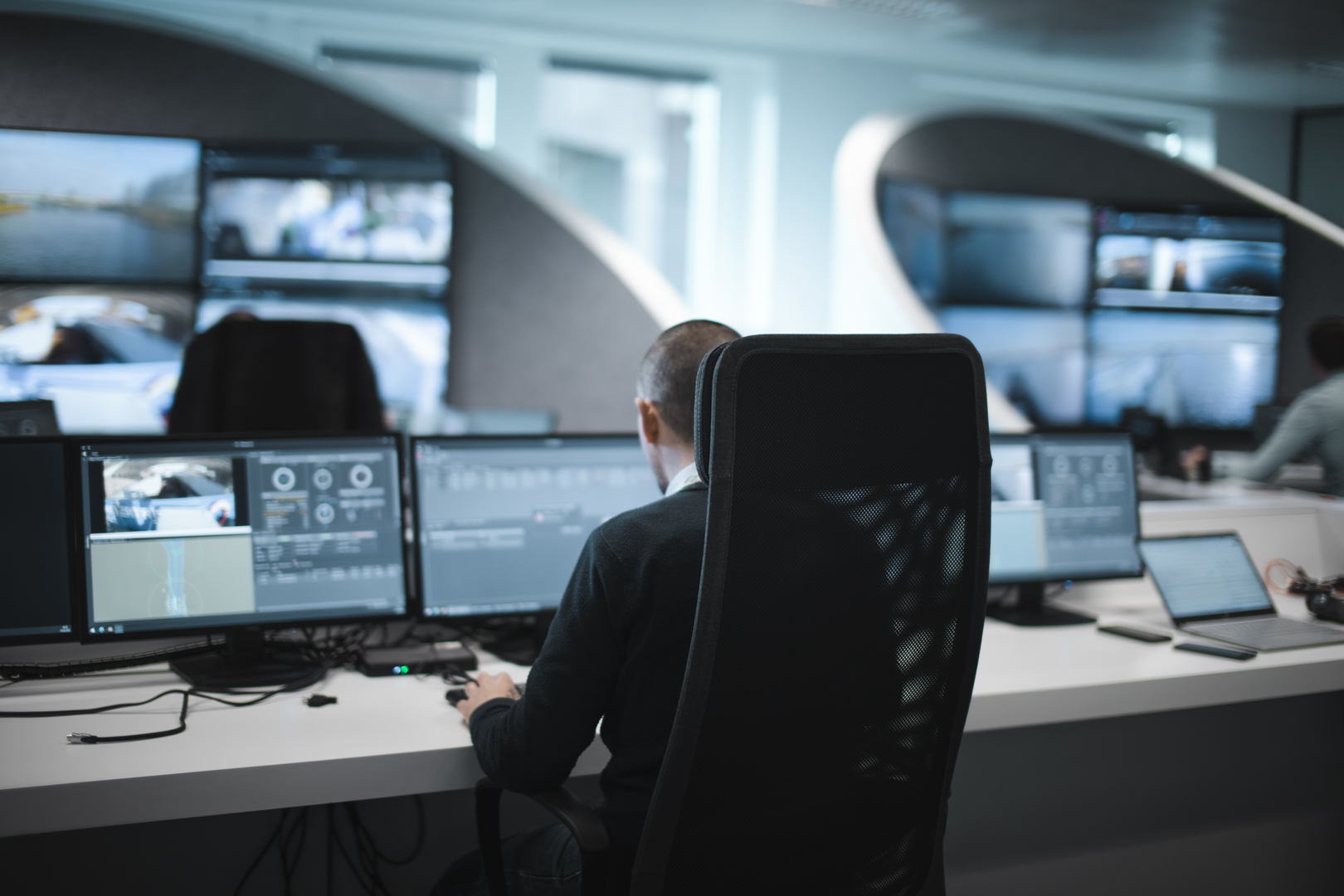
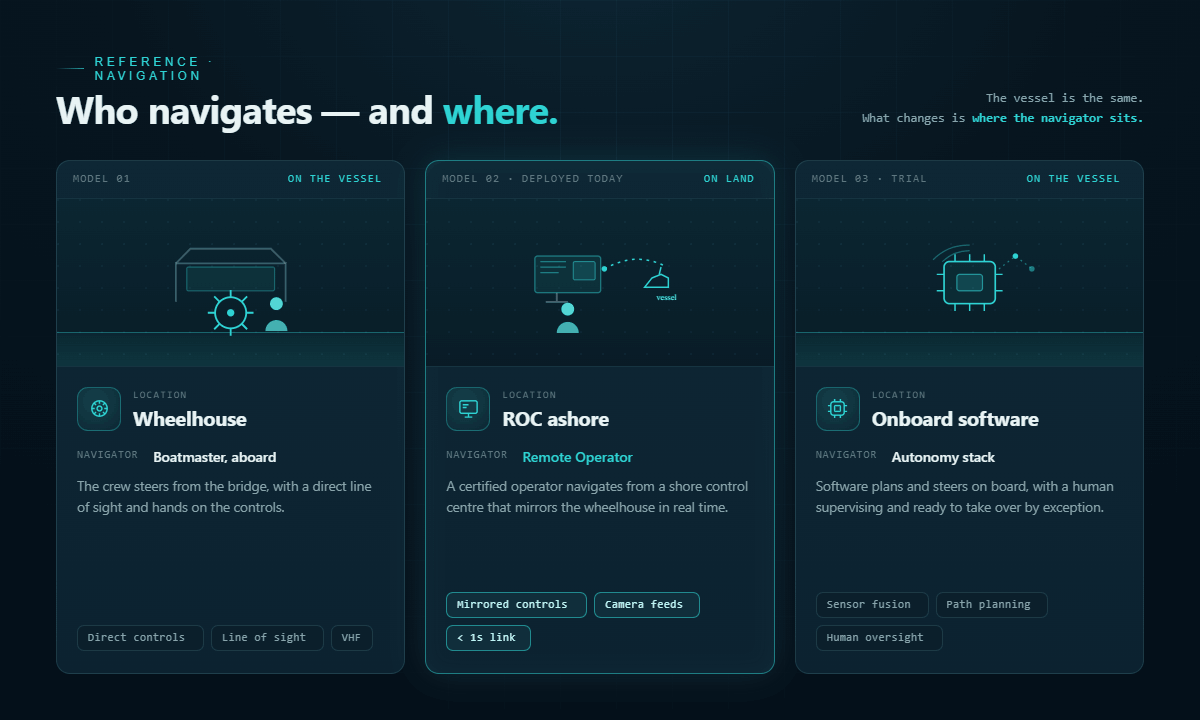
Track-keeping holds a vessel on a set course or track while the boatmaster stays in the wheelhouse. Remote vessel operations moves the navigational task itself to a certified Remote Operator ashore. One is an assistance function on a conventionally crewed vessel. The other changes who is navigating, and therefore what crewing the vessel is permitted to sail with.
- Track-keeping, often referred to by the generic term TGAIN or track-keeping, keeps the vessel on a heading or track. The crewing requirement does not change.
- Remote vessel operations transfers control to a Remote Operator in a Remote Operation Center. This is what makes crew-reduced sailing possible, and it needs a permit.
- Under the CCNR definition of levels of automation, remote control is not classified as a form of automation at all. Steering and track-keeping assistance is.
- They are complementary rather than competing. Many vessels running remote operations also have track-keeping installed.
The difference in one sentence
Track-keeping changes how the vessel is steered. Remote vessel operations changes who steers it, and from where.
That distinction sounds academic until it reaches the crew list. A vessel with track-keeping carries exactly the crew its operating mode requires, because a person in the wheelhouse is still performing the navigational task. A vessel operating remotely, under an authorisation, may sail with fewer people on board because part of that task has moved ashore.
What track-keeping does
Track-keeping is an assistance function. It holds the vessel on a set heading or a set track, correcting for current and wind, so the boatmaster is relieved of continuous small steering corrections. Related functions include a rate-of-turn regulator, which controls how quickly the vessel changes heading.
What it does not do is take responsibility. The boatmaster remains in the wheelhouse for the whole voyage, remains in command, and intervenes whenever the situation requires it. Traffic, lock approaches, passing arrangements and anything unexpected stay with the person on board.
Because nothing about the crewing arrangement changes, fitting track-keeping requires no permit beyond the usual equipment approvals. That is a real advantage: it is a straightforward installation with no regulatory pathway attached.
What remote vessel operations does
Remote vessel operations moves the navigational task off the vessel. A Vessel Control System on board is interfaced with the existing steering, propulsion and navigation equipment, and sends sensor, camera, radar and AIS data ashore over a redundant, secured connection. A certified Remote Operator in a Remote Operation Center monitors the voyage and, when control has been formally transferred, navigates the vessel.
The transfer is explicit. On a Seafar installation the boatmaster authorises every handover at the Console, and every handover is logged. Control does not drift ashore, and there is no moment at which it is unclear who is navigating.
Because this does change the crewing arrangement, it requires authorisation. Permission is granted per vessel, per route and per operating mode, usually as a derogation from existing crewing and navigation rules. That is the trade: a materially different commercial outcome, in exchange for a regulatory process.
Track-keeping and remote operations, side by side
| Track-keeping (TGAIN) | Remote vessel operations | |
|---|---|---|
| Who performs the navigational task | The boatmaster, in the wheelhouse | A certified Remote Operator, ashore |
| Where the decision is made | On board | In a Remote Operation Center |
| Effect on the crewing requirement | None | Enables crew-reduced sailing under a permit |
| Permit required | No, beyond normal equipment approval | Yes, per vessel, route and operating mode |
| CCNR classification | Falls within the levels of automation | Not classified as automation |
| What it solves | Workload and precision while steering | Crew availability as a constraint on utilisation |
| Typical installation effort | Equipment fit | System, connectivity, operator training, regulatory dossier |
Why the regulator draws the line differently than suppliers do
This is the part most comparisons miss, and it is the clearest evidence that the two are different in kind rather than in degree.
The Central Commission for the Navigation of the Rhine adopted an international definition of levels of automation in inland navigation in 2018, and published an updated explanatory note in 2022. It describes six levels, from level 0, where a person performs the entire navigational task with no automation, through to level 5, full automation. Steering and track-keeping assistance sits within that scale.
Remote control does not. Under the CCNR definition, remote control is not treated as a form of automation at all. A remotely operated vessel is not positioned somewhere on the autonomy ladder. It is a separate arrangement in which a qualified person remains fully responsible and works from a different place.
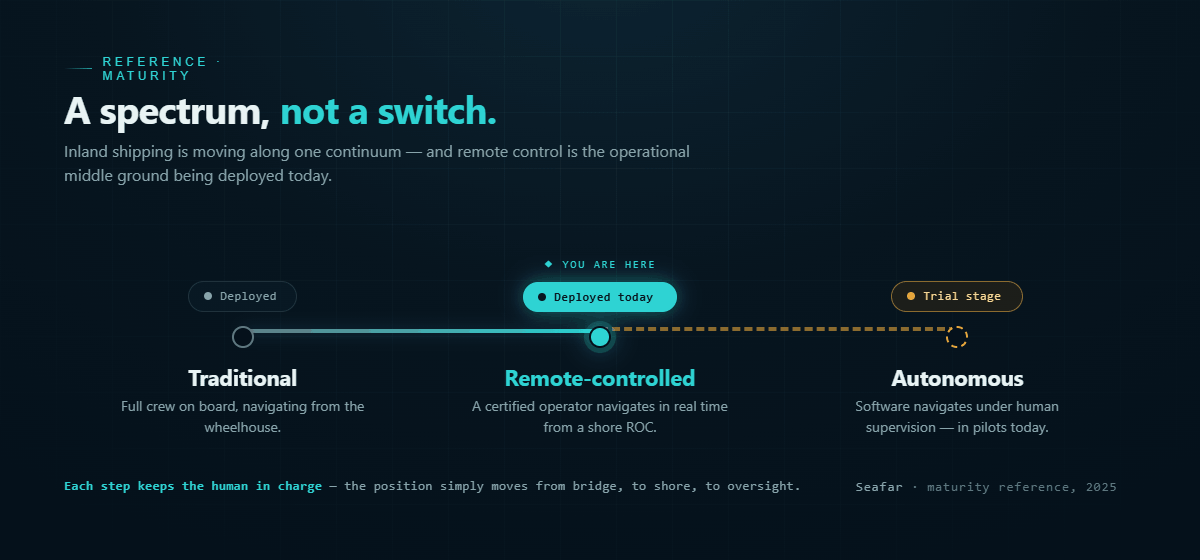
So a supplier who presents remote operation as the next step up from track-keeping is describing a progression the regulator does not recognise. They are two different answers to two different problems.
Does the crew still stay on board?
With track-keeping, yes, in full. With remote operations, usually yes, but with fewer people.
On most vessels operating remotely today a boatmaster remains on board. Control transfers ashore only for the stretches the permit covers, only with that boatmaster's authorisation, and always logged. Where connectivity or system health drops below a defined threshold, the vessel reverts to a predetermined safe state and control returns on board, to the person who is already there.
Sailing with no navigational crew on board is possible in specific, narrowly permitted circumstances, and it remains the exception rather than the normal case. Anyone comparing the two technologies on the assumption that remote operation means an empty wheelhouse is comparing against something that mostly does not exist.
They are not alternatives
The framing of this article is a comparison because that is how the question arrives, but the honest answer is that choosing between them is usually a category error. Many vessels operating under remote support also have track-keeping installed, and the two work together: the assistance function helps whoever is navigating, whether that person is in the wheelhouse or in a control room.
A closer analogy than competing products: asking whether to fit cruise control or to hire a driver.
Which one do you actually need?
Start from the constraint rather than the technology.
- 01Workload and precision
If the problem is workload and precision on long straight stretches, and your crewing is adequate, track-keeping addresses it directly with no regulatory pathway.
- 02Crew availability
If the problem is that voyages are delayed or refused because no qualified boatmaster is available, no amount of steering assistance will help. That is a crew availability problem, and it is what remote operations addresses.
- 03Both, which is common
If both are true, fit both. They are not in tension.
The practical test is the one a fleet owner can run alone: over the past year, how many voyages moved or did not happen, and was the reason cargo, route, or crew? If the answer is crew, the comparison in this article resolves itself.
Want that assessed for a specific vessel and route?
Talk to our team. We will tell you if the answer is track-keeping.
Assess your routeSources
- Central Commission for the Navigation of the Rhine, Definition of levels of automation in inland navigation (Resolution 2018-II-16, explanatory note updated 2022).
- Central Commission for the Navigation of the Rhine, Terminology relating to automated navigation and remotely operated craft (November 2023).
Questions readers ask
What is the difference between a TGAIN and remote vessel operations?
Track-keeping, generically TGAIN, holds a vessel on a set heading or track while the boatmaster stays in the wheelhouse and remains in command. Remote vessel operations transfers the navigational task to a certified Remote Operator ashore. Track-keeping changes how the vessel is steered. Remote operations changes who steers it, and therefore what crewing the vessel may sail with.
Does the crew still stay on board with remote vessel operations?
On most vessels operating remotely today a boatmaster remains on board. Control transfers ashore only for the stretches the permit covers, only with the boatmaster's authorisation, and always logged. If connectivity or system health falls below a defined threshold, control returns on board to that person. Sailing without navigational crew is possible only in narrowly permitted circumstances.
Is track-keeping the same as autonomous shipping?
No. Track-keeping is an assistance function performing part of the steering task while a person remains in command. Under the CCNR definition of levels of automation, steering and track-keeping assistance falls within the automation scale at a low level, well short of full automation. Autonomous shipping, at the top of that scale, has a system making the navigational decisions.
Is remote control a step above track-keeping?
Not in regulatory terms. Under the CCNR definition of levels of automation, remote control is not classified as a form of automation at all, so it does not sit above track-keeping on any scale. It is a different arrangement in which a qualified person remains fully responsible while working ashore. Suppliers who present it as the next step describe a progression the regulator does not recognise.
Do I need a permit for track-keeping?
No, beyond the normal equipment approvals, because the crewing arrangement does not change. Remote vessel operations does require authorisation, granted per vessel, per route and per operating mode, usually as a derogation from existing crewing and navigation rules. That regulatory pathway is typically the longest item in a remote operations project.
Can a vessel have both track-keeping and remote operations?
Yes, and many do. The two are complementary rather than competing. Track-keeping assists whoever is performing the navigational task, whether that person is in the wheelhouse or in a Remote Operation Center. Choosing between them is usually a category error rather than a genuine decision.