The Inland Shipping Crew Shortage Is Structural, Not Cyclical
Why the shortage of qualified captains is a permanent shift in maritime crew management, and what that means for how professional fleets are run.
Most operational problems in inland shipping eventually resolve. A hard winter passes. A fuel spike settles. A congested corridor clears. The temptation is to file the crew shortage under the same heading and wait for it to correct itself. That would be a mistake. The shortage of qualified captains is not a dip in a cycle. It is a structural break in the way the sector staffs its vessels, and it changes the question every fleet owner has to answer.
The distinction matters because it dictates the response. A cyclical shortage is a pricing problem. You pay more, wait it out, and supply returns. A structural shortage is a model problem. The people are not coming back in the numbers the sector needs, so the way vessels are operated has to change instead. Treating a structural shortage as a cyclical one means competing ever harder for a pool that keeps shrinking.
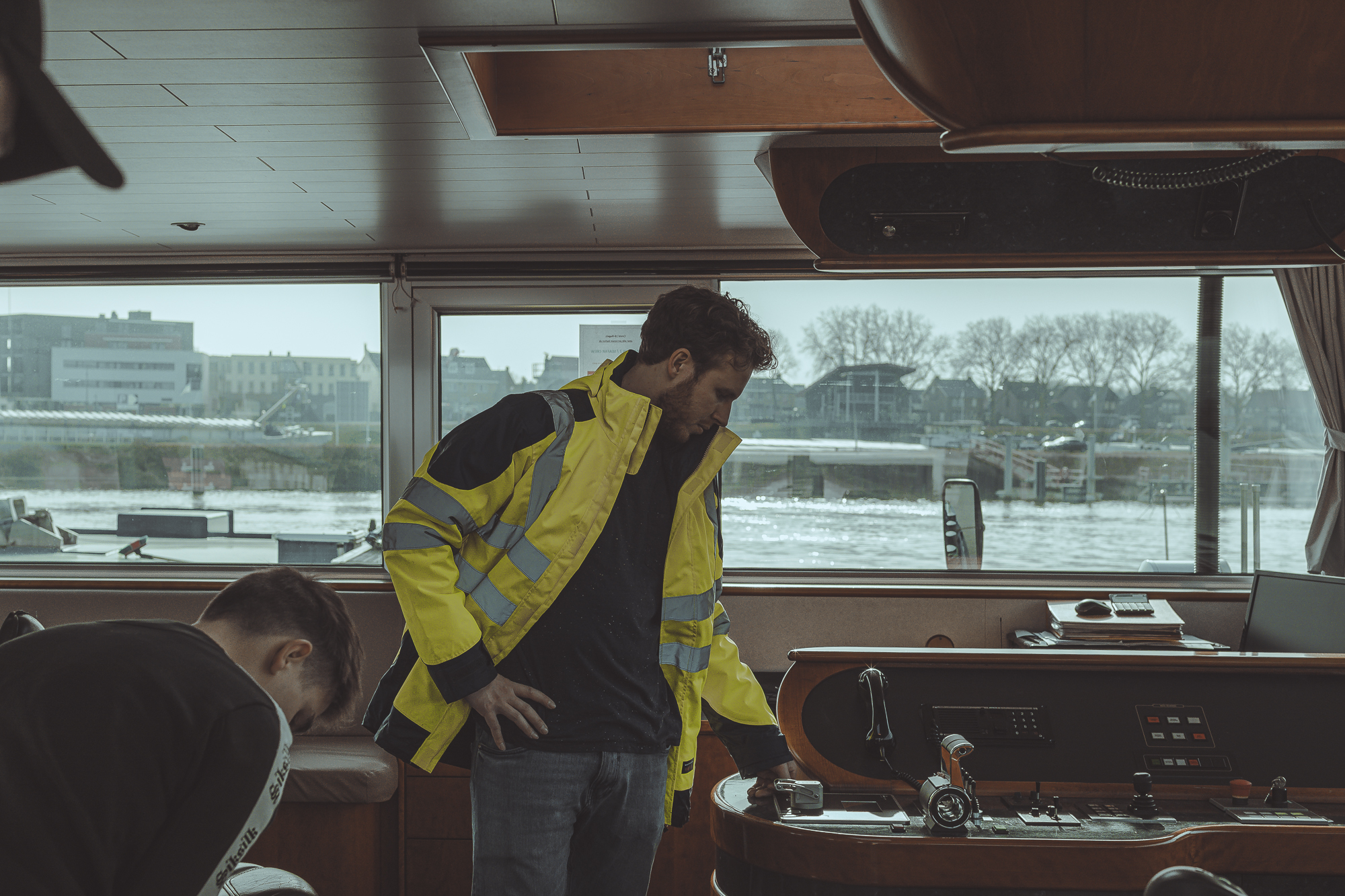
What makes this shortage structural
Three forces are working at the same time, and none of them reverses on its own.
The first is demographic. The generation of captains that built the modern inland fleet is retiring, and the pipeline behind them is thin. This is not a hiring freeze that thaws when conditions improve. It is a cohort leaving the workforce permanently and too few entrants replacing them.
The second is lifestyle. The traditional inland shipping career asks people to spend weeks at a time onboard, away from home, on continuous duty. Younger workers with maritime aptitude are choosing shore-based careers that let them sleep in their own beds. The profession is competing for talent against every other industry that offers a normal home life, and on that measure it has been losing.
The average age of inland waterway crew in Western Europe exceeds 50 years, with fewer young professionals entering the profession.
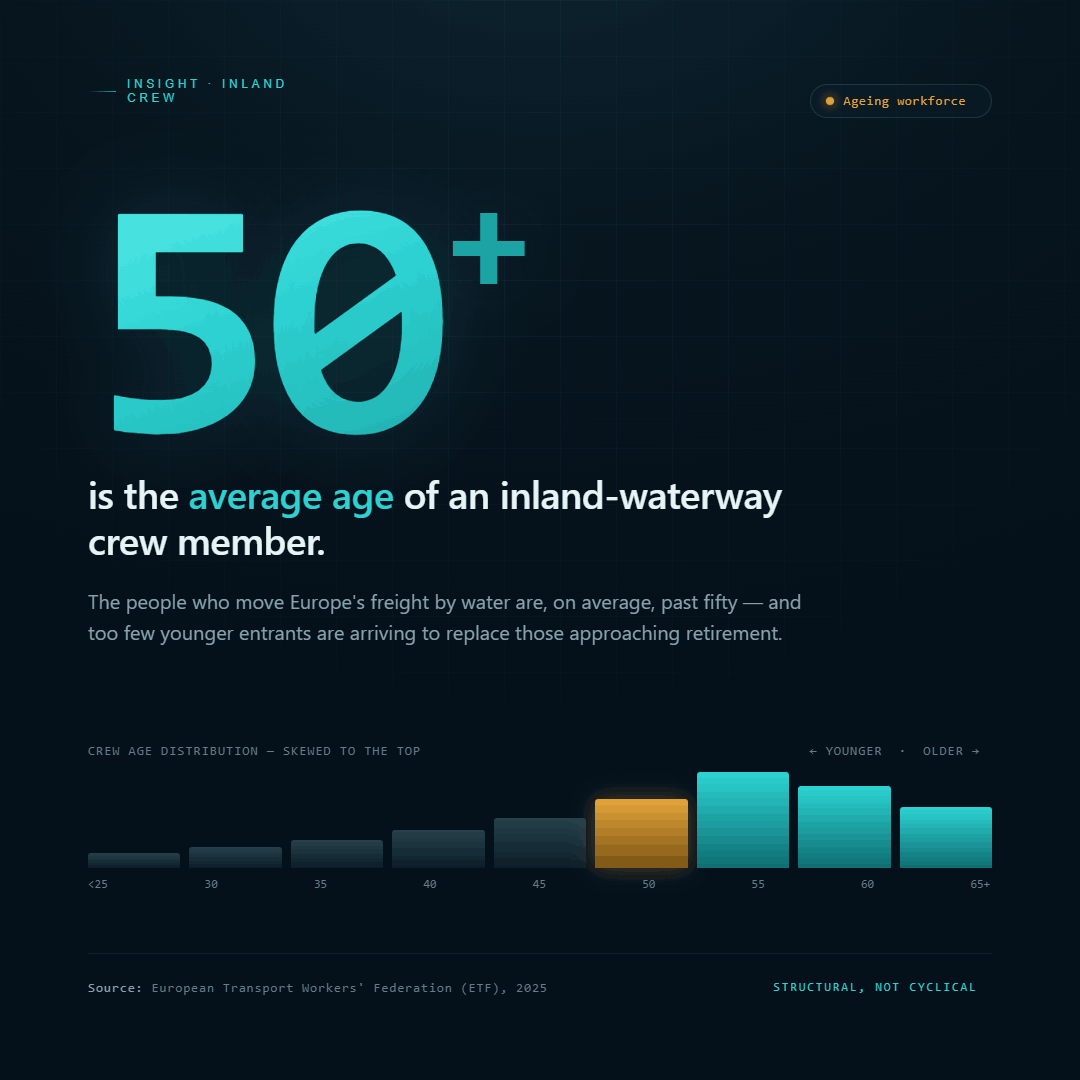
The pattern is not primarily about pay. Wages in inland shipping have risen over time, yet trainee numbers remain low, because the objection is to the working life itself, not the salary. Raising pay in a profession people no longer want to enter does not refill the pipeline.
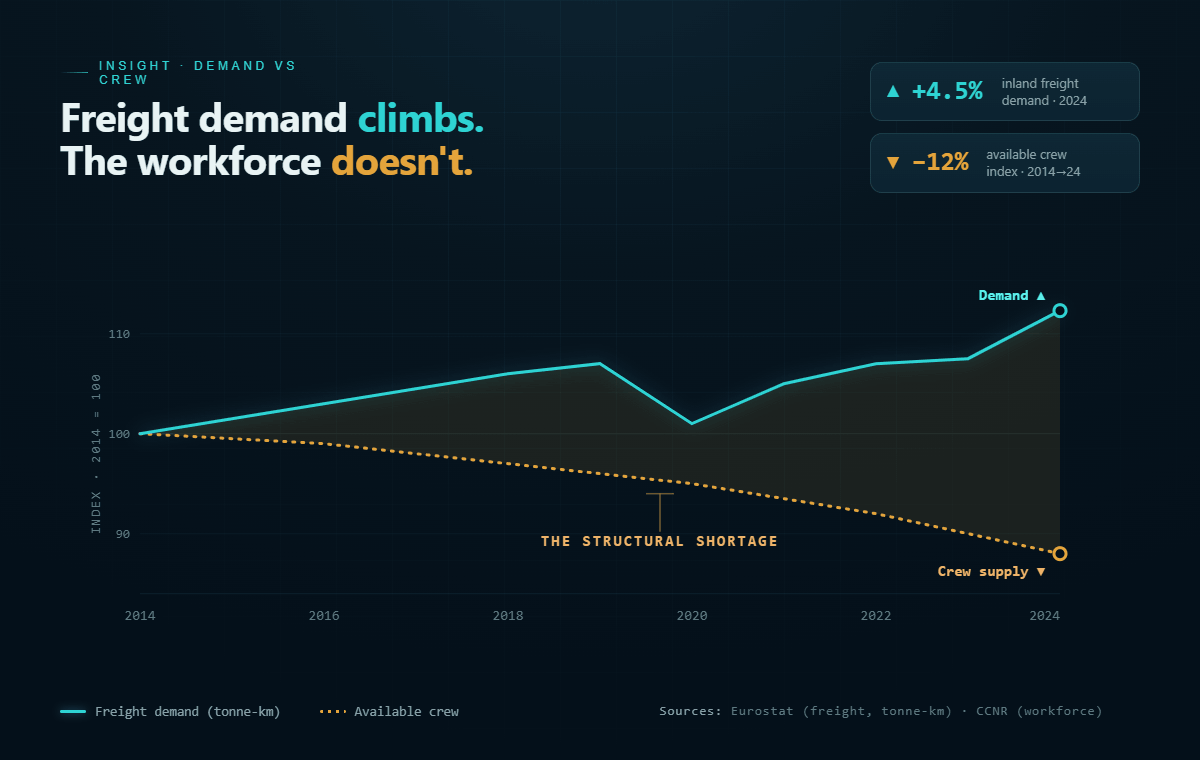
The third is demand. Inland shipping remains one of the most efficient and lowest-emission ways to move freight across Europe. Volumes are not falling. So the gap is not caused by less work. It is caused by fewer qualified people to do the same or growing amount of work. A shortage where demand holds and supply structurally declines does not self-correct.
EU inland waterway freight transport performance increased by 4.5% in 2024 compared with 2023.
Why the usual responses run out
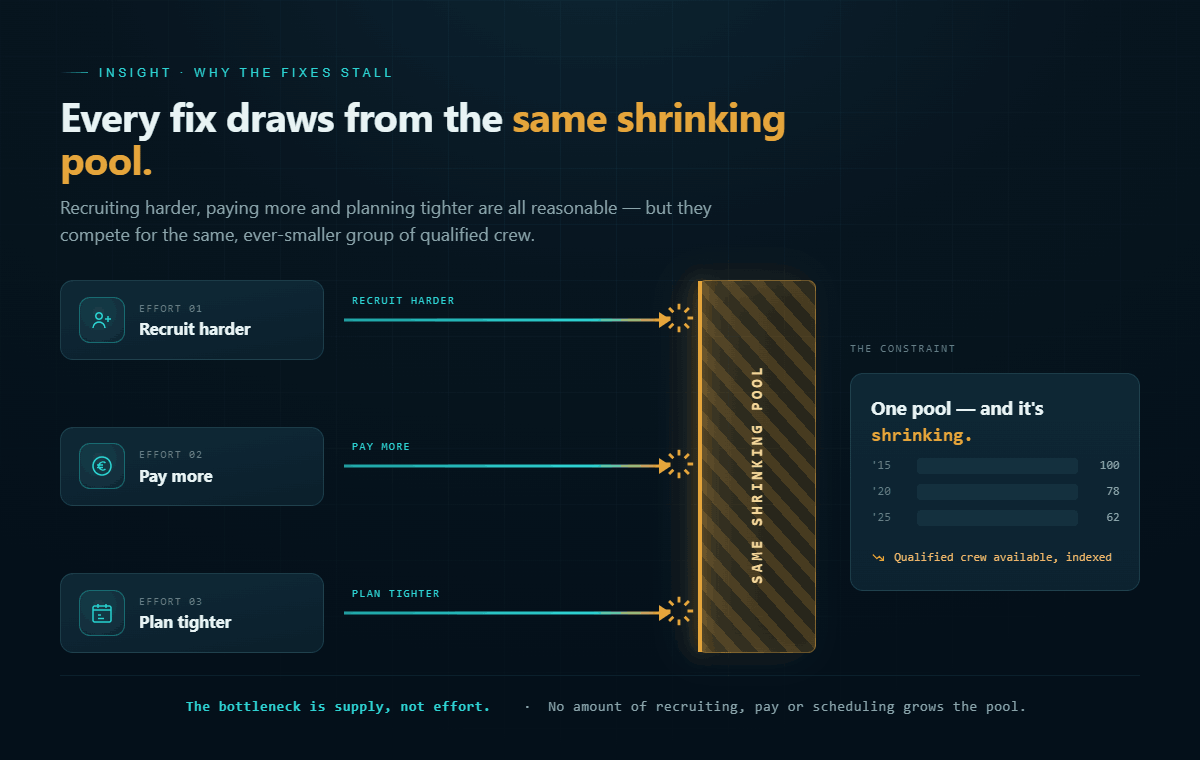
Faced with a shortage, the instinctive moves are to recruit harder, pay more, and plan tighter. Each has a ceiling.
Recruiting harder works only if there are people to recruit. When the shortage is structural, every operator is fishing the same shrinking pond, and aggressive recruitment mostly moves the same scarce captains between fleets at rising cost. Paying more has the same limit. It changes who employs the available crew, not how many are available. And tighter planning, squeezing more voyages out of the crew you have, eventually collides with fatigue, safety and the simple fact that a person cannot be in two wheelhouses at once.
Freight rates stayed resilient partly because of rising personnel costs, driven by a shortage of skilled workers.
Crew matchmaking platforms help fleets find the people who do exist, and that has real value. But finding a captain and creating one are different things. Matchmaking redistributes scarce supply. It does not expand it. When the shortage is in the total number of qualified people, a more efficient market for those people does not close the gap.
The shift: change the model, not the search
If the constraint is the number of qualified people who must be physically onboard, the durable answer is to reduce how many need to be onboard in the first place. That is the shift from a crewing problem to an operating-model question.
Remote vessel operations does exactly this. Instead of relying entirely on a single captain onboard for every vessel, navigation is supported from shore. A vessel is connected to a Remote Operation Center, where experienced Remote Operators support the voyage in real time. The vessel, the onboard crew where present, and the shore team operate as one connected system. Expertise that used to be locked to one wheelhouse can now support navigation across the fleet.
This is not automation replacing people, and it is not the same as a steering assistant. A TGAIN keeps the captain onboard and holds a course. Remote operations enables genuine shore-based operation. The expertise is still human and still essential. What changes is where it sits and how far it reaches. One team of Remote Operators can support more vessels than the equivalent number of captains confined to individual wheelhouses.
What changes for the fleet
When the operating model absorbs the shortage instead of fighting it, three things change for the owner.
Continuity stops depending on filling every onboard seat. A voyage no longer stalls because one qualified person is unavailable. Scale stops being capped by headcount. A fleet can add vessels without adding proportional onboard crew, because shore-based support spreads across the fleet. And planning becomes more predictable, because the operation is built around a resource the operator can actually grow, distributed expertise, rather than one it cannot, the raw number of captains in the labour market.
The crew shortage is real, serious, and here to stay. The fleets that treat it as a passing inconvenience will spend the coming years paying more to compete for a pool that keeps shrinking. The fleets that treat it as a signal to change how vessels are operated will keep sailing regardless. That is the choice the structural nature of this shortage forces. It is not about waiting for the market to recover. It is about running the fleet in a way that no longer depends on the recovery happening.
Questions readers ask
What is causing the inland shipping crew shortage?
The shortage is driven by a generational break rather than a market cycle. Experienced captains are retiring, and fewer young people are entering the profession because the traditional inland shipping lifestyle, weeks away from home and continuous onboard duty, competes poorly against shore-based careers. Demand for inland transport remains strong, so the gap between the vessels that need to sail and the qualified people available to sail them keeps widening.
Is the inland shipping crew shortage temporary or permanent?
It is structural, not cyclical. A cyclical shortage corrects itself when pay rises or the economy shifts. A structural shortage reflects a permanent change in the underlying supply, in this case a shrinking pool of qualified captains and a training pipeline that is not replacing them fast enough. Waiting for it to reverse is not a viable plan.
How are inland shipping fleets responding to the crew shortage?
Some fleets compete harder for the same scarce captains through higher pay and recruitment. Others change the operating model itself so that fewer qualified people are needed onboard. Remote vessel operations, where shore-based Remote Operators support navigation from a Remote Operation Center, reduces dependency on onboard crew and lets a fleet keep sailing even when captains are hard to find.
Can a fleet grow without hiring more captains?
Under the traditional model, no, because every vessel needs a qualified captain onboard. A crew-reduced model changes that equation. When navigation can be supported from shore, one team of Remote Operators can support multiple vessels, so a fleet can add capacity without adding proportional onboard crew.